
Are You at Risk? STOP-BANG Questionnaire
A validated screening tool used worldwide to identify adults who may be at risk for obstructive sleep apnea (OSA). Eight quick yes/no questions, a score, and what to do next — reviewed by Dr. Yolanda Cruz in downtown Toronto.
The STOP-BANG questionnaire is a validated screening tool used to identify individuals who may be at risk for obstructive sleep apnea. It does not constitute a diagnosis. A high score is a signal — not a verdict — that further evaluation by a sleep physician is appropriate. From a dental perspective, Dr. Yolanda Cruz can assess your airway, review your screening result with you, and facilitate referral when one is warranted. Book an evaluation or call 416-595-5490.

What is the STOP-BANG questionnaire?
STOP-BANG is an 8-item yes/no screening tool developed to flag adults at risk for obstructive sleep apnea (OSA). The acronym covers eight risk factors — four symptom-based ("STOP") and four anatomic / demographic ("BANG"). Each "yes" answer is worth one point, for a possible total of zero to eight.
It is widely used in pre-surgical anaesthesia screening, primary-care intake, and dental airway evaluation because it is short, evidence-based, and well validated against polysomnography (the in-lab sleep study that confirms or excludes OSA).
STOP-BANG is a screen, not a diagnosis. A formal diagnosis of sleep apnea can only be made by a physician following a sleep study.
Reviewed by Dr. Yolanda Cruz, DDS · Dr. Yolanda Cruz Dentistry On The Path · Toronto, ON
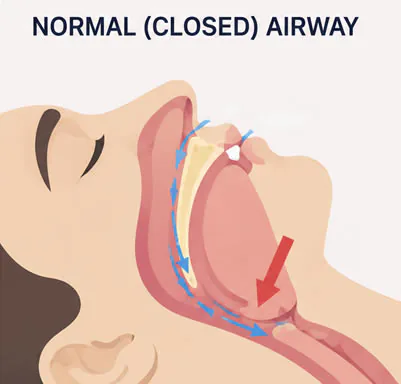
Why screening for sleep apnea matters
Untreated obstructive sleep apnea is associated with daytime fatigue, impaired concentration, cardiovascular strain, and an elevated long-term risk of metabolic and cognitive conditions. Many patients never connect their snoring, restless sleep, or morning headaches to a treatable medical problem.
A short, validated screening like STOP-BANG is one of the simplest ways to identify candidates for further sleep evaluation. Patients seen at this practice complete the questionnaire as part of a broader airway-focused exam — see our pages on what sleep apnea is and sleep apnea treatment for the bigger picture.
If you're new to this topic and want background reading before scoring yourself, the sleep tips for snoring and sleep apnea page is a good starting point.
STOP — the symptom-based questions
The four "STOP" questions cover symptoms and conditions that frequently accompany obstructive sleep apnea. Answer yes or no for each.
- S – Do you snore loudly (loudly enough to be heard through a closed door, or to disturb your bed partner)?
- T – Do you often feel tired, fatigued, or sleepy during the day?
- O – Has anyone ever observed you stop breathing, or gasp or choke, during your sleep?
- P – Do you have or are you being treated for high blood pressure?
BANG — the anatomic & demographic questions
The four "BANG" questions cover physical risk factors strongly associated with obstructive sleep apnea in adults.
- B – Is your body mass index (BMI) greater than 35?
- A – Are you over the age of 50?
- N – Is your neck circumference greater than 40 cm (approximately 16 inches)?
- G – Are you male?
All 8 questions in card form
Use this grid as a quick visual checklist. Tally your "yes" answers across all eight cards.
Snoring
Do you snore loudly — loud enough to be heard through a closed door, or to disturb your bed partner?
Tired
Do you often feel tired, fatigued, or sleepy during the day?
Observed apnea
Has anyone ever observed you stop breathing, or gasp or choke, during your sleep?
Pressure
Do you have or are you being treated for high blood pressure?
BMI
Is your body mass index (BMI) greater than 35?
Age
Are you over the age of 50?
Neck
Is your neck circumference greater than 40 cm (approximately 16 inches)?
Gender
Are you male?
Interpreting your score
The thresholds below come directly from the validated STOP-BANG scoring guidance. Use them to understand where your total falls — not to self-diagnose.
Score 0–2
Low risk for OSA
A low score is reassuring but not absolute. Watch for new or worsening symptoms (snoring, daytime fatigue, observed apnea) and re-screen if they appear.
Score 3–4
Intermediate risk
An intermediate score warrants a conversation with your physician or dentist. A formal sleep study may be recommended depending on the clinical picture.
Score 5–8
High risk for moderate-to-severe OSA
A score of 5 or higher signals high risk for moderate-to-severe OSA. Referral to a sleep physician for a sleep study is generally recommended.
What to do with your score
If your score suggests you may be at risk, we encourage you to contact our office. A formal diagnosis of sleep apnea can only be made by a physician following a sleep study.
Dr. Cruz can evaluate your airway from a dental perspective, discuss the findings with you, and facilitate a referral to a sleep physician if one is appropriate.
- Step 1. Save or print your score and the questions you answered "yes" to.
- Step 2. Book an airway-focused dental evaluation — request an appointment or call 416-595-5490.
- Step 3. Bring the form, along with any prior sleep history, to your visit.
- Step 4. If clinically appropriate, Dr. Cruz will refer you to a sleep physician for a formal sleep study (polysomnography or home sleep apnea test).
- Step 5. Once OSA is diagnosed, treatment options — including dental sleep apnea treatment with an oral appliance — can be discussed.
A dentist's role in airway screening
Dentists see patients more frequently than most physicians do — usually twice a year. That gives the dental visit a unique screening opportunity. Soft-tissue findings (a crowded posterior airway, a scalloped tongue, worn dentition consistent with bruxism), neck circumference, and patient-reported snoring and daytime sleepiness can all be assessed during a routine appointment.
Dr. Cruz uses STOP-BANG together with a focused airway examination to decide whether a patient should be sent for a formal sleep study. If a sleep study confirms OSA, follow-up care can include custom oral appliance therapy in coordination with the patient's sleep physician.
"STOP-BANG is one of the simplest screening tools in medicine, and one of the most useful. A 60-second questionnaire can identify a patient whose chronic snoring or unexplained fatigue is actually a treatable medical condition. My job is to recognize the pattern, score it consistently, and send the patient to the right place for a definitive answer."
— Dr. Yolanda Cruz, DDS, Dr. Yolanda Cruz Dentistry On The Path, Downtown Toronto
Limits of any screening tool
- A high score on STOP-BANG does not diagnose sleep apnea — only a sleep study can confirm or exclude it.
- A low score does not guarantee you are free of OSA. Symptoms can be subtle, especially in younger adults and pre-menopausal women.
- BMI and neck circumference are imperfect proxies for airway anatomy. Slim patients with crowded oropharynges can still have significant OSA.
- The questionnaire is validated for adults. It is not designed for paediatric airway screening.
- Self-reported snoring and observed apnea are most accurate when a bed partner is available to confirm. Patients sleeping alone may under-report.
- Screening results should always be interpreted in clinical context — with your physician, dentist, or sleep specialist.
Frequently asked questions about STOP-BANG
STOP-BANG is an 8-item yes/no screening tool used worldwide to identify adults who may be at risk for obstructive sleep apnea. The acronym covers four symptom-based questions (Snoring, Tired, Observed apnea, blood Pressure) and four anatomic / demographic questions (BMI, Age, Neck circumference, Gender). Each "yes" answer is worth one point. It does not diagnose sleep apnea — only a physician-ordered sleep study can do that.
The validated thresholds are: 0–2 = low risk, 3–4 = intermediate risk, and 5–8 = high risk for moderate-to-severe OSA. In addition, two or more "yes" answers in the STOP section alone is considered a possible risk signal. Higher scores correspond to a higher probability of obstructive sleep apnea on a formal sleep study.
No. A formal diagnosis of sleep apnea can only be made by a physician following a sleep study. A dentist's role is screening, airway examination, and — once a physician has diagnosed OSA — providing alternatives such as oral appliance therapy. Dr. Cruz uses STOP-BANG alongside a clinical airway exam and facilitates referral to a sleep physician when indicated.
A sleep physician will order either an in-lab polysomnogram or a home sleep apnea test, depending on your risk profile. The study records breathing, oxygen levels, heart rate, and sleep stages overnight. Based on the apnea-hypopnea index (AHI) the physician will confirm or exclude OSA and recommend treatment. If oral appliance therapy is appropriate, Dr. Cruz can fabricate a custom appliance in coordination with that physician.
Yes — STOP-BANG is a screening tool, not a diagnostic gold standard. Some patients with significant OSA (particularly younger or non-obese patients, or pre-menopausal women) can score low. If you have persistent snoring, observed apnea, or unexplained daytime fatigue despite a low score, raise it with your physician or dentist anyway.
No. STOP-BANG was developed and validated in adults. Paediatric airway screening uses different tools and different anatomic considerations — if you have concerns about a child's snoring or sleep-disordered breathing, raise them with your child's physician or paediatric dentist.
Medical Disclaimer
This content is for informational and educational purposes only and does not constitute medical or dental advice, diagnosis, or treatment. The STOP-BANG questionnaire is a screening tool; it cannot diagnose obstructive sleep apnea. A formal diagnosis requires a sleep study ordered and interpreted by a physician. Individual results vary. Consult Dr. Yolanda Cruz, your physician, or another qualified healthcare professional regarding your symptoms, screening result, and any treatment options.
Concerned about your STOP-BANG score?
Book an airway-focused dental evaluation with Dr. Cruz on the PATH at Bay & Queen. We'll review your screening result, examine your airway, and coordinate a sleep-physician referral if one is appropriate.