
Jaw Pain, Headaches, or Sleep Problems? TMJ & TMD Care Downtown Toronto (The Path)
Dr. Yolanda Cruz is a general dentist in Downtown Toronto with a focused practice in TMJ disorders and sleep-disordered breathing. If these conditions are affecting your daily life, we offer a thorough diagnostic process and a range of non-surgical treatment options.
This page is the starting point for the TMJ/TMD section of the practice. It introduces what temporomandibular joint disorder is, what the symptoms look like, why Dr. Cruz approaches it the way she does, and how the diagnostic and treatment process unfolds. From here you can jump to any of the focused pages in the section — on individual symptoms, treatments, diagnostic technology, or self-care — or book a TMJ consultation directly.
Do any of these sound familiar?
- Jaw pain or tenderness
- Clicking or popping in the jaw
- Chronic headaches or migraines
- Facial or neck pain
- Difficulty chewing or opening your mouth
- Teeth grinding or clenching (bruxism)
- Morning fatigue or unrefreshing sleep
- Loud snoring or witnessed breathing pauses
- CPAP intolerance
- Ringing in the ears (tinnitus)
If several of these sound familiar, a thorough evaluation may help identify whether TMJ dysfunction or sleep-disordered breathing is a contributing cause.
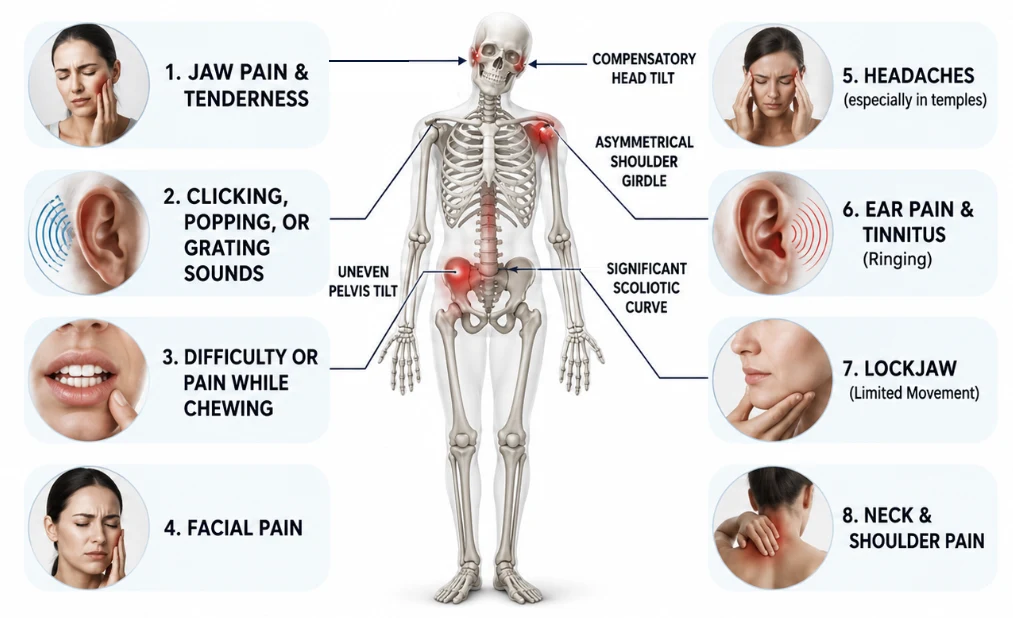
What temporomandibular joint disorder is
The temporomandibular joints connect the lower jaw to the skull just in front of each ear. They work together with the masseter, temporalis, and pterygoid muscles to allow speaking, chewing, swallowing, and yawning. When the joints, the disc inside them, the surrounding muscles, the bite, or the nerves controlling them stop working in coordination, the result is a temporomandibular disorder — usually abbreviated as TMJ or TMD.
TMJ/TMD is not a single condition. It is a family of related problems that can present as joint sounds (clicking, popping, grating), muscle pain, headaches, ear symptoms, restricted opening, locking, or a bite that no longer feels right. Two patients with the same diagnosis can have very different starting points.
Because TMJ/TMD overlaps with sleep-disordered breathing, bruxism, and posture, evaluation at this practice is comprehensive rather than focused on a single trigger.

A focused practice, conservative care
A focused practice. Dr. Cruz is a general dentist who has directed her practice toward the assessment and treatment of TMJ disorders, headache and facial pain, and sleep-disordered breathing. Patients receive care from a dentist who has invested significantly in this area of practice.
Diagnostic technology. Our office uses T-Scan, Joint Vibration Analysis (JVA), Fotona laser therapy, 3D CBCT imaging, and iTero digital scanning as part of our diagnostic and treatment process.
Personalized, non-surgical care. Every treatment plan is built around your individual diagnosis. We prioritize conservative, reversible therapies and take the time to ensure you understand every step of your care.
Reviewed by Dr. Yolanda Cruz, DDS · Dr. Yolanda Cruz Dentistry On The Path · Toronto, ON
Services offered at this practice
The TMJ/TMD section of the practice covers diagnostic, treatment, and self-management services. Each is matched to the patient's individual diagnosis.
- TMJ / TMD assessment and treatment
- Sleep apnea & snoring
- Oral appliance therapy
- Botox for TMJ & bruxism
- Fotona laser therapy (NightLase®)
- Bruxism (teeth grinding) guards
About this practice
If you or someone you love wakes up with headaches, jaw or facial pain, or feels unrefreshed after sleep, you may be experiencing a temporomandibular disorder and/or sleep-disordered breathing. At our practice, every patient receives an individualized treatment plan based on careful diagnosis and a thorough review of their overall health.
Dr. Yolanda Cruz is a general dentist. TMJ and sleep-disordered breathing services are provided within the scope of general dentistry.
Call us at 416-595-5490 or book online to schedule your exam.
Your path to relief — step by step
Care is delivered as a sequence, not a single appointment. The first visit is diagnostic; treatment begins only after a working diagnosis is in place.
Identify your symptoms
Jaw pain, headaches, poor sleep, or snoring may be connected.
Comprehensive assessment
In-depth exam including bite analysis, joint evaluation, airway screening, and digital diagnostics (T-Scan, JVA, CBCT).
Personalized diagnosis
We determine whether TMJ dysfunction, sleep-disordered breathing, or both are contributing.
Conservative treatment plan
Custom oral appliances, bite therapy, laser therapy, or other non-surgical options.
Ongoing monitoring & adjustments
We track your progress and refine your treatment for long-term results.
Six things to know about TMJ/TMD
These are the points patients tell us are most useful to understand before reading further into the section.
It's a family of conditions, not one
TMJ/TMD covers joint problems, muscle problems, bite problems, and the interaction between them. The plan depends on which is driving the symptoms.
Most cases are managed conservatively
Custom oral appliances, Botox to the muscles, laser therapy, and home care address the vast majority of presentations without surgery.
Diagnosis comes before treatment
The first visit is a comprehensive evaluation. No appliance is fabricated and no Botox is given on day one.
It overlaps with sleep-disordered breathing
Bruxism and TMD are commonly linked with snoring, sleep apnea, and CPAP intolerance — which is why airway screening is part of the exam.
Headaches and ear symptoms can be involved
Tension-pattern headaches, ear pressure, fullness, and tinnitus often improve when the underlying muscle and joint load is reduced.
Self-treatment with a drugstore guard can make it worse
Generic boil-and-bite night guards can add bulk without controlling occlusal contacts. A custom appliance is designed against your bite.
Dr. Cruz's clinical note
"TMJ/TMD is a confusing label because so many things hide behind it. My job at the first visit is to name what's actually happening — muscle, joint, disc, bite, airway, or some combination — before any treatment is recommended. Once that's clear, the plan is straightforward and we work in small reversible steps."
"I'm a general dentist, not an oral surgeon. The vast majority of TMJ/TMD I see can be managed without surgery — but I'll always tell you when it's time to consult one."
— Dr. Yolanda Cruz, DDS, Dr. Yolanda Cruz Dentistry On The Path, Downtown Toronto
Frequently asked questions about TMJ/TMD
TMJ/TMD is a family of disorders of the temporomandibular joint and the surrounding muscles, nerves, and bite. Symptoms can include jaw pain, joint clicking or popping, headaches, facial or neck pain, difficulty chewing or opening, teeth grinding, ear pressure or tinnitus, and a bite that feels off. Two patients with the same diagnosis can present very differently, which is why a comprehensive evaluation is the starting point.
TMJ/TMD has multiple possible contributors rather than a single cause: bruxism (clenching and grinding), bite imbalance, disc displacement, arthritic changes in the joint, muscle hyperactivity, stress, and sleep-disordered breathing can all play a role. The evaluation at this practice is designed to identify which contributors apply to your individual presentation.
Diagnosis starts with a clinical exam — a focused conversation about your symptoms, history, sleep, and stress; gentle palpation of the muscles and joints; and a range-of-motion assessment. Digital tools used as part of the diagnostic process include T-Scan occlusal analysis, Joint Vibration Analysis (JVA), 3D CBCT imaging, and iTero digital scanning. See your visit & diagnostic process for the step-by-step.
Treatment is conservative and non-surgical wherever clinically appropriate. The options offered within the scope of general dentistry include custom oral appliances, Botox for the masseter and temporalis muscles, Fotona laser therapy, T-Scan and JVA for ongoing monitoring, jaw exercises, dietary guidance during flare-ups, and patient education. See TMJ treatment for the full overview.
They commonly overlap. Bruxism, jaw posture, and airway dynamics during sleep are linked — which is why airway screening is part of the TMJ evaluation, and why pages about sleep apnea, snoring, and the STOP-BANG questionnaire live in the same section of the site. See the TMJ-airway connection.
The practice is at 390 Bay St., Concourse Level, Unit C006 — on the PATH at the corner of Bay & Queen, downtown Toronto. Call 416-595-5490 or request an appointment online to schedule a TMJ evaluation.
Medical Disclaimer
This content is for informational purposes only and does not constitute dental or medical advice, diagnosis, or treatment. TMJ/TMD disorders have multiple possible causes and treatment outcomes vary by individual. Some cases require referral to an oral and maxillofacial surgeon or another specialist. Consult Dr. Yolanda Cruz or another qualified dental professional regarding your symptoms and treatment options. Individual results may vary.
Ready for a TMJ/TMD evaluation in downtown Toronto?
Book a focused TMJ evaluation with Dr. Cruz. You'll leave with a working diagnosis and a written plan — no commitment to treatment on day one.