
Oral Appliances for TMJ & Sleep in Downtown Toronto
Custom-fabricated orthotic splints, bruxism night guards, and mandibular advancement devices — designed, fitted, and adjusted by Dr. Yolanda Cruz at our office on the PATH at Bay & Queen.
Oral appliances are custom-designed dental devices worn during sleep. At Dr. Yolanda Cruz's downtown Toronto practice they are used to manage two distinct but overlapping problems: TMJ/TMD dysfunction — including bruxism, joint loading, and disc pathology — and sleep-disordered breathing such as snoring and mild-to-moderate obstructive sleep apnea. Because the same patient often has both, every appliance is matched to a working diagnosis rather than fitted off a shelf. Schedule an oral-appliance consultation or call 416-595-5490.
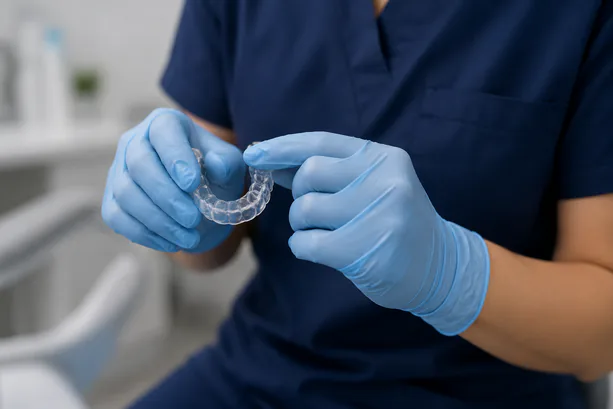
Diagnosis before device — always
An oral appliance is a clinical tool, not a product. Before any device is recommended Dr. Cruz completes a comprehensive evaluation: joint and muscle palpation, range-of-motion assessment, T-Scan occlusal analysis, articulating-paper bite check, and — when indicated — Joint Vibration Analysis and CBCT imaging. Sleep-related cases also require a physician-issued polysomnography (sleep study) diagnosis before a mandibular advancement device is fitted.
Only when the working diagnosis is clear does the conversation turn to which appliance — if any — is appropriate. A young clencher with masseter hypertrophy, an arthritic TMJ with disc displacement, and a snorer with confirmed mild OSA each need a different design.
Dr. Yolanda Cruz is a general dentist. Oral appliance therapy is provided within the scope of general dentistry; severe or refractory cases are co-managed with sleep physicians or oral and maxillofacial surgeons as needed.
Reviewed by Dr. Yolanda Cruz, DDS · Dr. Yolanda Cruz Dentistry On The Path · Toronto, ON
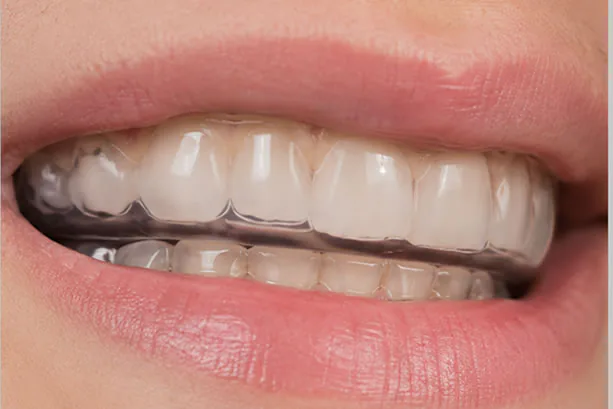
Three appliance families — chosen by diagnosis
Each appliance below is provided by Dr. Cruz within the scope of general dentistry. Each is matched to specific diagnostic findings; none is used as a one-size-fits-all solution.
- TMJ orthotic splints. Hard acrylic appliances that reposition and stabilize the mandible to decompress the temporomandibular joint, reduce strain on the articular disc, and unload the masticatory musculature. Used to address the orthopedic component of TMD — see TMJ stabilization appliance and orthopedic TMJ treatment.
- Bruxism night guards. Designed to protect tooth enamel and restorations from the destructive forces generated by nocturnal grinding and clenching. Available in hard acrylic or dual-laminate (hard outside, soft inner liner) depending on bruxism intensity, occlusal contacts, and patient tolerance.
- Mandibular advancement devices (MADs). Custom-fitted intra-oral appliances that hold the lower jaw in a slightly forward position during sleep, widening the pharyngeal airway and reducing the soft-tissue collapse that drives snoring and obstructive sleep apnea. Provided only after a sleep physician has issued a polysomnography-based diagnosis — see our sleep apnea treatment page.
Many patients need more than one device over time — for example, a daytime light orthotic during a TMD flare-up and a separate nighttime appliance for bruxism protection.
Why custom fabrication matters
Over-the-counter "boil-and-bite" appliances and drugstore night guards are not clinically equivalent to a custom-fitted device. A properly fabricated appliance requires:
- Accurate intra-oral scanning or dental impressions of both arches
- A bite registration captured at the clinically appropriate vertical dimension
- Mounting on a semi-adjustable articulator or use of digital occlusal mapping (T-Scan)
- Fabrication in dental-grade hard acrylic, dual-laminate, or thermoplastic material — matched to bruxism intensity and joint findings
- An in-office fitting appointment with occlusal adjustment using articulating paper and T-Scan
- A follow-up adjustment series over the first 8–12 weeks as the appliance settles and the bite responds
Per the position of the Canadian Sleep Society and the American Academy of Dental Sleep Medicine, oral appliances for sleep-disordered breathing should be fabricated by dentists trained in dental sleep medicine and titrated under clinical supervision. A drugstore device can sometimes worsen TMD by adding bulk between the teeth without controlling where the occlusal contacts fall.
Is an oral appliance right for you?
An oral appliance is generally appropriate to consider if you have any of the following:
- Diagnosed bruxism — visible tooth wear, chipping, fractured restorations, or a partner reporting loud grinding
- TMJ pain, clicking, locking, or tension-pattern headaches confirmed on TMD evaluation
- An arthritic TMJ or history of disc displacement where joint decompression is part of the plan — see managing the arthritic TMJ
- Diagnosed mild-to-moderate obstructive sleep apnea (AHI 5–30) where a sleep physician has approved oral appliance therapy
- CPAP-intolerant patients with confirmed OSA who have a physician's referral for a MAD trial
- Heavy snoring — once a sleep study has ruled out untreated severe OSA
An oral appliance may not be the right starting point if you have severe untreated obstructive sleep apnea (typically AHI > 30) requiring CPAP, advanced unrestored decay or active periodontal disease, insufficient remaining teeth to retain a device, or a known TMJ structural problem that needs surgical assessment first. In those cases Dr. Cruz will coordinate care with the appropriate physician or specialist.
What fitting feels like
Most patients tell us the appliance process is far less invasive than they expected. Across two or three visits the experience looks like this:
- Visit one — records. A focused conversation about symptoms, sleep, and prior treatment. Intra-oral scanning (or impressions) of both arches, bite registration, photographs, and a T-Scan baseline. No injections, no drilling, no appliance worn home.
- Visit two — fit. The appliance is seated; Dr. Cruz checks retention, comfort, and the occlusal scheme using articulating paper and T-Scan. Adjustments are made in the chair. Most patients describe initial wear as "snug but not painful" — similar to the feel of a sports mouthguard but thinner and more precisely fitted.
- Visit three and beyond — adjustment. Follow-up at 2–3 weeks, then again at 8–12 weeks. The appliance is refined as the muscles and joint respond. For MADs, the device is titrated in small increments under symptom and (where required) repeat sleep-study guidance.
You will not leave the first visit with an appliance — that's by design. A written plan and a personalized cost estimate are provided before fabrication begins.
The clinical work an appliance does
A well-designed appliance addresses the contributing factors rather than just masking the symptom — here are the most common goals.
Protects tooth structure
A custom night guard absorbs and redistributes bruxism forces, sparing enamel, restorations, crowns, and implants from accelerated wear, chipping, and fracture.
Decompresses the TMJ
An orthotic splint repositions the mandible to reduce intra-articular loading, give the displaced disc room to recapture, and unload the lateral pterygoid.
Reduces muscle hyperactivity
By controlling occlusal contacts, the appliance interrupts the bruxism feedback loop — masseter and temporalis activity falls during sleep, lowering morning soreness.
Opens the airway (MAD)
A mandibular advancement device holds the lower jaw — and the tongue base attached to it — slightly forward, widening the pharyngeal airway and reducing apnea events and snoring.
Calms tension headaches
When jaw-muscle hyperactivity contributes to recurrent temple or behind-the-eye headaches, an appliance often reduces both frequency and intensity within several weeks.
Reversible & non-surgical
An oral appliance is a conservative, non-invasive option. If it isn't working it can be discontinued — nothing about the underlying bite or jaw has been permanently altered.
Appliance options compared
The table is a general orientation only — the appropriate device is determined by the diagnostic workup. Several patients use more than one design over time.
| Appliance | Primary indication | Material / design | Typical wear | Reversible? |
|---|---|---|---|---|
| TMJ orthotic / stabilization splint | TMD, joint loading, disc pathology | Hard acrylic, full coverage, custom occlusal scheme | Nightly — sometimes daytime during flare | Yes |
| Bruxism night guard (hard acrylic) | Heavy nocturnal grinding, protecting restorations | Rigid acrylic, single arch, balanced contacts | Nightly | Yes |
| Bruxism night guard (dual-laminate) | Mild–moderate bruxism, comfort-sensitive patients | Hard outer shell, soft inner liner | Nightly | Yes |
| Mandibular advancement device (MAD) | Diagnosed mild–moderate OSA or CPAP-intolerant OSA | Two-piece, titratable forward advancement (SomnoDent, Narval, etc.) | Nightly — titrated incrementally | Yes — with a brief AM bite re-set |
| Drugstore boil-and-bite | Not recommended for TMD or OSA | Generic thermoplastic, no bite control | Variable | Yes — but can worsen some presentations |
What patients usually want to know
"Will it be uncomfortable to sleep with?"
An adjustment period of 1–2 weeks is normal. Most patients adapt within the first three or four nights. If discomfort persists, the appliance is adjusted — a properly fitted device should feel snug but not painful, and you should be able to talk through it briefly.
"How much does a custom appliance cost in Toronto?"
Cost varies with appliance type (a single-arch night guard differs from a two-piece titratable MAD), materials, and the included fitting and adjustment visits. After the records appointment you receive a written treatment plan with a personalized estimate. Many Canadian extended-health plans cover part of a custom occlusal appliance; MADs for diagnosed OSA may also be partially covered — we'll help with pre-authorization. Schedule a consultation for a personalized estimate.
"How long does an appliance last?"
A well-cared-for hard-acrylic appliance lasts approximately 3–5 years; dual-laminate and softer materials may need replacement sooner. Heavy bruxers wear through devices faster — significant wear is itself a clinical finding worth documenting.
"I've already tried a drugstore night guard — why isn't that enough?"
A boil-and-bite device adds bulk between the teeth without controlling where the occlusal contacts fall. For routine enamel protection it may suffice; for TMD it can sometimes deepen the problem. A custom appliance is designed against your bite using T-Scan and articulating-paper data and is adjusted across follow-up visits as the joint and muscles respond.
"Can I get a MAD without a sleep study?"
No. Mandibular advancement devices are provided only after a sleep physician has issued a polysomnography-based diagnosis. For snoring without confirmed OSA we still recommend a sleep evaluation first — treating snoring with a MAD without ruling out severe OSA can leave a more serious condition undertreated.
Dr. Cruz's clinical note
"The most common mistake I see — in patients who arrive having spent a few hundred dollars on a drugstore night guard — is that the device was bought to treat a symptom rather than designed to address a diagnosis. A grinding problem in one patient is muscle-driven, in another it's a sleep-airway problem, in a third it's a bite-disharmony problem. The appliance for each looks different. That's why I won't fabricate one without doing the workup first — the most important hour of appliance therapy is the one that happens before any plastic is made."
"For sleep-apnea patients I work alongside their sleep physician. A MAD is a fantastic option for the right candidate — particularly those who can't tolerate CPAP — but it isn't a substitute for the diagnosis. Snoring deserves a sleep study first."
— Dr. Yolanda Cruz, DDS, Dr. Yolanda Cruz Dentistry On The Path, Downtown Toronto
Risks & considerations
- An adjustment period of 1–2 weeks is common — expect mild jaw soreness, excess salivation, or transient changes in how the bite feels on waking
- Over time, an oral appliance — particularly a MAD — can produce small bite changes; periodic monitoring and follow-up visits are part of safe use
- Hard-acrylic appliances can break under heavy bruxism forces; significant wear or fracture is itself a clinical finding and should be reported
- Mandibular advancement devices require a physician-issued polysomnography diagnosis of sleep apnea; they are not a substitute for CPAP in severe OSA
- An appliance does not "cure" bruxism, TMD, or sleep apnea — it manages the condition; some patients need ongoing wear and monitoring
- Drugstore appliances used without professional evaluation may worsen some TMD presentations and miss an undiagnosed sleep-disordered breathing problem
- Severe joint pathology or refractory TMD may need referral to an oral and maxillofacial surgeon; severe OSA may need a sleep-medicine specialist
Frequently asked questions about oral appliances
An oral appliance is a custom-designed dental device worn during sleep to manage TMJ disorders, nocturnal bruxism, or sleep-disordered breathing. At Dr. Cruz's downtown Toronto practice we provide three families — TMJ orthotic splints, bruxism night guards, and mandibular advancement devices — each chosen on the basis of a clinical evaluation and (for MADs) a physician-issued sleep study. Every appliance is designed against the patient's own bite using intra-oral scanning, T-Scan occlusal analysis, and articulating-paper data.
Coverage varies. Many Canadian extended-health and dental plans cover part of a custom occlusal appliance for bruxism or TMD; mandibular advancement devices for diagnosed OSA may be partially covered under either health or dental benefits. We provide documentation for pre-authorization wherever possible. The CDCP page outlines what's eligible under the federal plan.
For muscle-dominant TMD and bruxism, many patients notice meaningful improvement — less morning soreness, fewer tension headaches — within 1–3 weeks of consistent nightly wear, with further gains as the appliance is adjusted over 8–12 weeks. For sleep-apnea patients, snoring improvement is often noticed by the bed partner within the first week of MAD titration; full apnea-event reduction is confirmed by a follow-up sleep study after the device is fully titrated.
No. A MAD is provided only after a sleep physician has issued a polysomnography-based diagnosis. This protects you from treating snoring while leaving undiagnosed obstructive sleep apnea (a medical condition with cardiovascular consequences) untreated. We coordinate with your physician and sleep clinic to make the referral pathway straightforward — see sleep apnea treatment.
Rinse the appliance under cool water after wear, brush gently with a soft toothbrush (no toothpaste — it's abrasive on acrylic), and store dry in its case during the day. A weekly soak in a non-bleach denture or appliance cleaner removes biofilm. Avoid hot water and any solvent — both can warp the device. Bring your appliance to every dental visit for inspection and adjustment.
The practice is at 390 Bay St., Concourse Level, Unit C006 — on the PATH at the corner of Bay & Queen, downtown Toronto. The TTC Queen station is one block away and there's underground parking nearby. Full directions and accessibility notes are on the parking & directions page.
Medical Disclaimer
This content is for informational purposes only and does not constitute dental or medical advice, diagnosis, or treatment. Oral appliance therapy is a clinical intervention; appropriate device selection depends on a comprehensive examination and, for sleep-related cases, a physician-issued polysomnography diagnosis. Treatment outcomes vary by individual. Some patients are not candidates for oral appliance therapy and may require alternative or specialist care (e.g., CPAP for severe OSA, oral and maxillofacial surgery for structural TMJ disease). Consult Dr. Yolanda Cruz or another qualified dental professional regarding your symptoms and options. Individual results may vary.
Considering an oral appliance in downtown Toronto?
Book a focused evaluation with Dr. Cruz. You'll leave with a working diagnosis, a clear answer on whether an appliance is the right tool, and — if it is — a written plan and cost estimate before any device is fabricated.