
Treating the Locked Jaw in Downtown Toronto
Closed-lock and open-lock TMJ presentations — conservative care, gentle manual reduction when appropriate, and a clear referral pathway for cases that need arthrocentesis or arthroscopy. Provided by Dr. Yolanda Cruz at our office on the PATH at Bay & Queen.
A locked jaw occurs when the displaced articular disc inside the temporomandibular joint blocks normal jaw opening — or, less commonly, blocks the jaw from closing. Instead of the usual clicking or popping that accompanies opening, the jaw simply stops, often at a significantly reduced opening of around 20–25 mm. Attempting to open wider causes pain in front of the ear and the chin may deviate to one side. While the experience is frightening and painful when it first occurs, jaw locking is actually a recognized stage in the natural course of many TMJ disorders, and it does not always require aggressive intervention. Dr. Yolanda Cruz evaluates and manages locking presentations within the scope of general dentistry, prioritizing conservative care and referring for closed-joint surgery (arthrocentesis or arthroscopy) only when clinically indicated. Schedule a focused TMJ evaluation or call 416-595-5490.
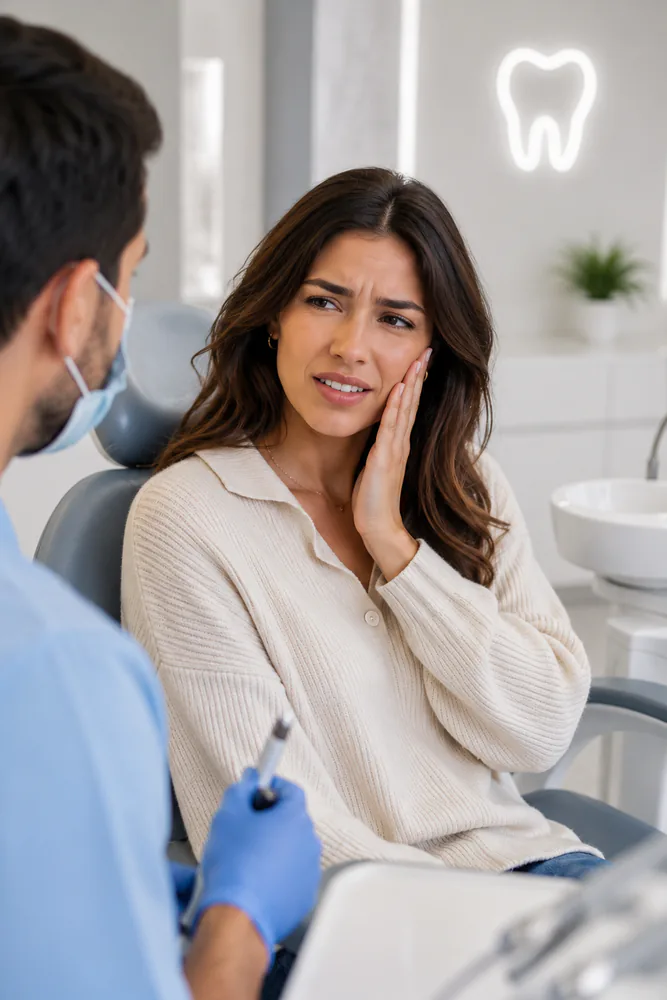
What a locked jaw actually is
The temporomandibular joint contains a small fibrocartilaginous disc that sits between the mandibular condyle and the glenoid fossa of the temporal bone. In a healthy joint, that disc glides smoothly with the condyle as the jaw opens and closes. In TMJ internal derangement, the disc is displaced — usually anteriorly and medially — and the condyle has to navigate around it.
For many patients, that's the clicking or popping stage: the condyle “catches” the disc on opening, the disc snaps back into position, and the jaw opens normally. A locked jaw happens when the disc no longer reduces — it stays displaced, and the condyle cannot translate past it. The opening stops short, the chin pulls toward the locked side, and the patient feels a hard mechanical block rather than a click.
Dr. Yolanda Cruz is a general dentist. All evaluation, splint therapy, and conservative reduction approaches described on this page are provided within the scope of general dentistry. Closed and open surgical interventions are coordinated with an oral and maxillofacial surgeon.
Reviewed by Dr. Yolanda Cruz, DDS · Dr. Yolanda Cruz Dentistry On The Path · Toronto, ON
Two very different presentations
Closed-lock — by far the more common — is when the disc blocks opening. The patient can usually close the jaw but cannot open beyond about 20–25 mm (a normal range is roughly 40–55 mm). The chin deviates toward the affected side, lateral movement away from the locked side is limited, and clicking that may have been present for months often suddenly stops — replaced by the hard block. This is “disc displacement without reduction.”
Open-lock — far less common — is when the condyle translates forward past the articular eminence and cannot return. The jaw stays open and the patient cannot close. This is a true subluxation/dislocation of the joint and typically needs immediate manual reduction by a clinician trained in the maneuver.
The distinction matters because the two presentations are managed differently. A closed-lock evaluation is what most patients arriving in our Toronto office are seeking. An acute open-lock that has just happened is usually managed in an emergency setting or by an oral and maxillofacial surgeon. For more on disc mechanics, read recapturing the dislocated disc and clicking & popping — what does it mean?
Acute vs chronic locking — why it matters
The duration of the lock changes both prognosis and approach. Two patients with apparently identical openings can have very different outlooks depending on how long the disc has been displaced and how the surrounding tissues have responded.
- Acute closed-lock (hours to a few days): the disc has recently failed to reduce, the surrounding tissues are inflamed but not yet remodeled. This is the window in which gentle manual reduction techniques and aggressive anti-inflammatory support have the highest chance of restoring full opening.
- Subacute closed-lock (weeks to a few months): the disc is still mechanically displaced but the joint has begun to adapt. Manual reduction is less likely to succeed; the priority shifts to stretching the retrodiscal tissues, decompressing the joint with an appropriate appliance, and preserving function.
- Chronic closed-lock (months to years): the retrodiscal tissue has remodeled, opening has often gradually improved, and the patient may already be functioning at 30–38 mm with minimal pain. Treatment focuses on long-term joint stability, bruxism control, and avoiding further insult.
In other words, the goal isn't always to recapture the disc — for many chronic cases, the joint has already found a new equilibrium, and forcing the disc back risks more harm than benefit.
The conservative pathway
In many cases, the jaw will gradually open more over time as the retrodiscal tissues adapt and the joint finds a new functional pattern. Sometimes that happens over days, sometimes over weeks or months. While the joint is adapting, the priority is to reduce loading and inflammation:
- Wearing a custom-fabricated TMJ stabilization appliance during sleep to decompress the joint and protect against bruxism — see TMJ stabilization appliance and oral appliances
- Short-term anti-inflammatory support to reduce capsular and retrodiscal inflammation
- A soft-food diet during the most symptomatic phase to limit joint loading
- Avoiding wide opening, yawning unprotected, and chewing gum until opening improves
- Gentle, guided range-of-motion exercises once acute pain settles — see managing TMJ symptoms at home
- Fotona or Weber laser therapy for pain modulation and tissue healing where appropriate — see TMJ dental laser therapy
- Botox to the masseter and temporalis for patients whose locking is associated with muscle hyperactivity — see Botox for TMJ & bruxism
Many patients with a locked jaw recover meaningful function with this conservative pathway alone, even without ever “unlocking” the disc in the mechanical sense. The joint adapts.
Unlocking the jaw — when reduction is appropriate
In some cases, particularly when the lock is recent (hours to a few days) and the surrounding muscles can be relaxed, it may be possible to guide the disc back into a more functional position. Muscle relaxation is essential to the reduction — a tightly-guarded lateral pterygoid will resist the maneuver, and a forced reduction against muscle guarding risks tissue injury.
The reduction itself is a gentle, distractive maneuver: downward pressure on the posterior mandible (typically with the operator's thumbs on the molars), combined with forward translation, allows the condyle to translate past the displaced disc. When successful, the patient feels a release and opening returns to a more normal range, usually with an immediate reduction in pain.
Adjuncts that improve the chance of a successful reduction include:
- Short courses of muscle relaxants or other medications, where appropriate, to reduce protective muscle guarding
- Application of moist heat to the masseter and temporalis before the maneuver
- Topical anesthetic infiltration of the most tender muscle trigger points
- Trigger-point pressure release of the lateral pterygoid prior to attempted reduction
- For some patients, gentle nitrous oxide sedation to lower anxiety and muscle tone
What recovery looks like
The recovery curve depends on whether the disc reduces, on the underlying joint condition (e.g., concomitant arthritic changes — see managing the arthritic TMJ), and on the patient's ability to follow a protective routine. Broadly:
- Days 1–7: the most symptomatic phase. Anti-inflammatory support, soft diet, and the protective appliance are key. Most patients see meaningful pain reduction within this window.
- Weeks 2–6: if the disc has not reduced, opening typically improves gradually as the retrodiscal tissues stretch. Functional opening (around 35–40 mm) is a realistic milestone for most patients in this window.
- Months 2–6: appliance adjustments, splint refinement, and re-evaluation with T-Scan and Joint Vibration Analysis to confirm the joint has stabilized — see TMJ/TMD diagnostic technology.
- Long-term: ongoing nighttime appliance wear, bruxism control, posture and stress management, and periodic check-ups to monitor for recurrence or progression.
Many patients who experience a closed-lock go on to do well long-term with conservative management and long-term appliance wear. The key principle — covered in the doctor's note below — is that the treatment should always be proportional to the severity of the symptoms.
Is this evaluation right for you?
A focused locked-jaw evaluation is generally appropriate if you are experiencing any of the following:
- A sudden inability to open your mouth wider than about two fingers (roughly 20–25 mm)
- Pain in front of the ear when you try to open wider, sometimes radiating to the temple or angle of the jaw
- Your chin pulls noticeably to one side when you open
- Clicking or popping that was present for months has now suddenly stopped — replaced by a hard block
- An open-mouth episode that you cannot close (this is urgent — usually managed in an emergency setting)
- A history of chronic limited opening that is now flaring with pain
- Locking that is recurrent — happens, releases on its own, then happens again
A locked-jaw evaluation at this practice may not be the right starting point if the lock is the result of a recent traumatic injury (a fall, an assault, a sports collision) — in that case, fracture must be ruled out by imaging in an emergency or oral surgery setting first. Open-lock episodes that are actively happening (jaw stuck open) are also usually managed in an emergency setting or by an oral and maxillofacial surgeon — see the note on surgery below.
What the appointment feels like
Most patients tell us the anticipation is worse than the visit itself. The first locked-jaw evaluation involves:
- A focused conversation about how and when the lock started, prior clicking history, any trauma, and any prior TMJ treatment
- Measurement of maximum interincisal opening with a millimeter ruler — you'll be asked to open as far as comfortable, no further
- Gentle palpation of the masseter, temporalis, and (carefully) the lateral pterygoid — you'll be asked to point out anything tender
- Assessment of lateral and protrusive movement — the pattern of deviation gives important diagnostic information
- Joint loading test, and Joint Vibration Analysis when indicated, to characterize the joint sounds and resistance
- Review of any prior imaging, plus a recommendation for 3D CBCT only if structural concerns (e.g., suspected condylar fracture or significant arthritic change) need to be ruled out — see imaging & after your examination
- An honest discussion of whether attempted manual reduction is appropriate at this visit, or whether the right path is splint therapy first and possible referral
No drilling, no extractions, no permanent treatment on day one — the first visit is diagnostic and, where appropriate, may include a gentle attempted reduction. A written plan and cost estimate follow before any further treatment begins.
What treatment can do for you
Targeted locked-jaw treatment is designed to manage acute pain, restore function, and reduce the chance of recurrence:
Rapid pain reduction
Anti-inflammatory support, a protective appliance, and laser therapy can meaningfully reduce acute pain within the first week, even when the disc itself does not reduce.
Restored opening
Whether through successful manual reduction or gradual adaptation, most patients regain functional opening (around 35–40 mm) within weeks to months.
Joint protection
A custom orthotic splint decompresses the joint, protects teeth from bruxism, and limits further insult during the most fragile phase.
Avoid unnecessary surgery
Most closed-lock presentations can be managed conservatively. Arthrocentesis and arthroscopy remain available if needed, but are not the starting point.
A clear plan
You leave the diagnostic visit knowing what's happening in the joint, what stage you're in, what to do this week, and when to expect re-evaluation.
Lower recurrence risk
Addressing bruxism, occlusal contributors, and muscle hyperactivity with appliance therapy and (when indicated) Botox reduces the chance of a second locking episode.
Manual reduction vs splint therapy vs arthrocentesis referral
Most locked-jaw plans use more than one of the options below in sequence. The table is a general orientation — the right combination depends on how long the lock has been present, the underlying joint condition, and the patient's symptom severity.
| Option | Best for | Reversible? | Typical timeline |
|---|---|---|---|
| Gentle manual reduction | Acute closed-lock (hours to a few days), muscle-relaxed patient | Yes | Attempted at the diagnostic visit; success is variable |
| Custom TMJ stabilization appliance | Every locked-jaw patient — protective and decompressive | Yes | Fitted in 2–3 visits; adjusted over 8–12 weeks |
| Anti-inflammatory + soft diet | Acute and subacute phase; reduces joint and tissue load | Yes | 1–3 weeks; tapered as symptoms improve |
| Botox to masseter/temporalis | Locking driven by muscle hyperactivity or recurrent bruxism | Yes — wears off in 3–4 months | Effect builds over 1–2 weeks |
| Fotona / Weber laser therapy | Pain modulation, inflammation, soft-tissue healing | Yes | A short series of sessions over weeks |
| Arthrocentesis (oral surgeon) | Closed-lock refractory to conservative care | Minimally invasive (small-needle joint lavage) | Single-session procedure; recovery in days |
| Arthroscopy (oral surgeon) | Cases where direct joint visualization is needed | Minimally invasive (small portal) | Single-session procedure; recovery in 1–2 weeks |
| Open joint surgery (oral surgeon) | Rare, severe, refractory cases with structural pathology | No | Coordinated with oral surgeon; longer recovery |
Dr. Cruz's clinical note
“Most patients who arrive with a freshly locked jaw are frightened. They had clicking for years that they ignored, and then one morning it just stopped — and they can't open. My first job is to name what's happening: this is disc displacement without reduction, it's a known stage of TMJ internal derangement, and it's almost always recoverable. I don't reach for force. The lateral pterygoid is guarding the joint for a reason, and I respect that. We relax the muscles, protect the joint with an appliance, and give the tissues time. Most of these patients open well within a few weeks — even when the disc never mechanically reduces.”
“The principle I keep coming back to: the treatment should always be proportional to the severity of the symptoms. Locking is the most symptomatic phase of many TMJ conditions, but it is typically just a phase. The patients who do worst are the ones who get pushed straight into aggressive manipulation or early surgery before the joint has had a chance to adapt.”
“I'm a general dentist, not an oral surgeon. The vast majority of locked-jaw presentations I see can be managed conservatively — but I'll always tell you, clearly, when it's time to consult one.”
— Dr. Yolanda Cruz, DDS, Dr. Yolanda Cruz Dentistry On The Path, Downtown Toronto
A note on closed-joint surgery and referral
Arthrocentesis — a procedure in which sterile fluid is gently flushed through the upper joint space using two small-gauge needles — can sometimes relieve a refractory closed-lock and reduce intra-articular inflammation. It is a closed (minimally invasive) procedure performed by an oral and maxillofacial surgeon, often in an office or outpatient setting, and recovery typically takes days.
Arthroscopy offers a slightly more involved version of the same approach, with the ability to directly visualize the joint through a small portal and perform limited interventions on adhesions or the disc itself. Recovery typically takes one to two weeks.
Open joint surgery — arthrotomy — is reserved for rare, severe cases where there is structural pathology that closed approaches cannot address. It carries a longer recovery and is considered only after conservative and closed-joint options have been fully explored.
Dr. Cruz will refer patients for surgical consultation when clinical findings suggest a closed approach is warranted — for example, a closed-lock that has not improved after 2–3 months of appropriate conservative care, or imaging that demonstrates significant intra-articular pathology.
Risks & considerations
- Not every closed-lock is a candidate for manual reduction — attempted reduction against significant muscle guarding can worsen tissue irritation and pain
- Even successful reduction does not guarantee long-term joint stability; ongoing splint wear and bruxism control are usually needed
- Some locked joints do not regain full pre-locking opening, even with appropriate conservative care — functional opening (around 35–40 mm) is a more realistic expectation than full opening (around 50–55 mm)
- Closed-lock cases that do not respond to several months of conservative care may need arthrocentesis or arthroscopy by an oral and maxillofacial surgeon
- Custom appliances require an adjustment period and may temporarily change how the bite feels
- Chronic locking can coexist with arthritic changes in the joint, which require their own management strategy
- Self-attempted “forcing” of a locked jaw — pulling on the chin, prying the mouth open — can injure the disc, retrodiscal tissues, or even the condyle, and is strongly discouraged
- Recurrent locking episodes are possible and require ongoing attention to bruxism, posture, and stress as contributors
Frequently asked questions about a locked jaw
A locked jaw is a TMJ presentation in which the displaced articular disc blocks normal jaw opening (closed-lock) or, less commonly, blocks closing (open-lock). At Dr. Cruz's downtown Toronto practice, treatment begins with a focused diagnostic visit that distinguishes closed-lock from open-lock, identifies how long the lock has been present, and assesses muscle and joint contributors. Conservative care — a custom TMJ stabilization appliance, anti-inflammatory support, soft diet, and gentle manual reduction when appropriate — is the starting point. Arthrocentesis or arthroscopy by an oral and maxillofacial surgeon is reserved for refractory cases.
It varies. Some acute closed-locks release spontaneously within hours or days. Others persist for weeks or months, with opening gradually improving as the retrodiscal tissues adapt. Many patients regain functional opening (around 35–40 mm) within 4–8 weeks of appropriate conservative care, even when the disc itself does not mechanically reduce. The goal is functional, comfortable opening — not necessarily a return to pre-locking range.
A closed-lock — jaw stuck partway open, unable to open wider — is not usually an emergency. It can be managed as a same-week dental visit. An open-lock — jaw stuck open, unable to close — is more urgent and is typically managed in an emergency department or by an oral and maxillofacial surgeon, particularly if it has just happened. If your lock is the result of recent trauma (a fall, a sports injury, an assault), seek emergency care first to rule out fracture.
Self-forcing — pulling on the chin, prying the mouth open, or aggressive stretching — is strongly discouraged. The lateral pterygoid is guarding the joint for a reason, and forcing against that guarding risks injuring the disc, the retrodiscal tissue, or the condyle. What you can safely do at home is apply moist heat to the masseter and temporalis, take an appropriate over-the-counter anti-inflammatory if you have no contraindications, eat a soft diet, and avoid wide opening or chewing gum — then book an evaluation. See managing TMJ symptoms at home.
Most patients do not. The majority of closed-lock presentations seen at this practice are managed conservatively with splint therapy, anti-inflammatory support, and (when indicated) Botox or laser therapy. Arthrocentesis and arthroscopy are reserved for cases that have not responded to several months of conservative care, or that have demonstrable intra-articular pathology on imaging. Open joint surgery is rarer still.
Coverage varies by plan. Many Canadian extended-health and dental plans cover part of the custom TMJ stabilization appliance and some diagnostic procedures. Botox for TMD and laser therapy are usually fee-for-service. We provide documentation for pre-authorization wherever possible. The CDCP page outlines what's eligible under the federal plan. Arthrocentesis and arthroscopy, when performed by an oral surgeon, are billed through that practice and may fall under OHIP or extended health depending on the case.
Medical Disclaimer
This content is for informational purposes only and does not constitute dental or medical advice, diagnosis, or treatment. Locked-jaw presentations have multiple possible causes and treatment outcomes vary by individual. Some cases — particularly acute open-lock, trauma-related locks, or cases refractory to conservative care — require referral to an oral and maxillofacial surgeon or emergency care. Consult Dr. Yolanda Cruz or another qualified dental professional regarding your symptoms and treatment options. Individual results may vary.
Locked jaw? Get a focused TMJ evaluation in downtown Toronto.
Book a same-week diagnostic visit with Dr. Cruz. You'll leave with a working diagnosis, a clear week-one plan, and an honest discussion of whether attempted reduction, conservative care, or referral is the right path — no commitment to treatment on day one.