
TMJ & TMD Treatment in Downtown Toronto
Conservative, non-surgical care for chronic jaw pain, clicking, headaches, and bite-related dysfunction — provided by Dr. Yolanda Cruz at our office on the PATH at Bay & Queen.
Dr. Yolanda Cruz provides comprehensive TMJ/TMD evaluation and treatment in downtown Toronto. Care begins with accurate diagnosis — a complete clinical exam, joint and muscle palpation, and (when indicated) imaging and bite analysis. Treatment is directed at the underlying cause of symptoms rather than masking them, and conservative, non-surgical approaches are prioritized whenever clinically appropriate. Schedule your TMJ consultation or call 416-595-5490.

Our Approach to Treatment
Appropriate treatment begins with accurate diagnosis. Before any treatment is recommended, a comprehensive examination is completed and a working diagnosis is established. The most suitable treatment option is always determined by the findings of that diagnostic process.
At Dr. Cruz's practice, conservative and non-surgical approaches are prioritized. Treatment is directed at the underlying cause of symptoms, not only symptom management.
Dr. Yolanda Cruz is a general dentist. All services described on this page are provided within the scope of general dentistry.
Reviewed by Dr. Yolanda Cruz, DDS · Dr. Yolanda Cruz Dentistry On The Path · Toronto, ON
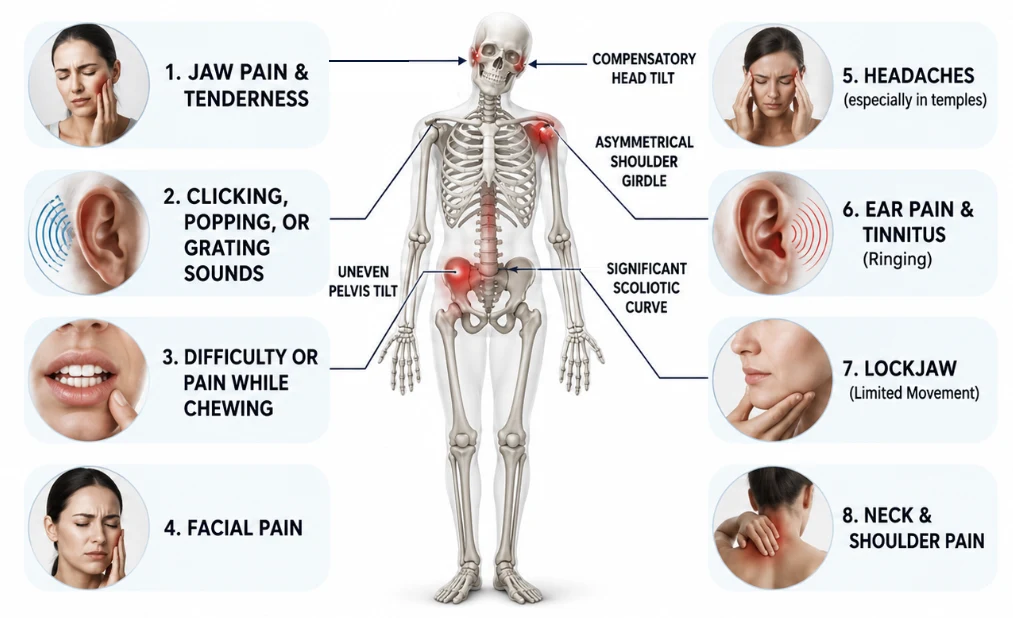
A multifaceted condition needs a multifaceted plan
Chronic TMJ/TMD is a multifaceted condition involving the joints, the surrounding muscles, the nervous system, and the bite. Effective treatment must consider each of these elements. Dr. Cruz approaches TMJ/TMD as both a musculoskeletal and neurological condition, working to reduce joint stress, address inflammation, and support the nervous system's return to a less sensitized state.
That means a plan for one patient — a young grinder with masseter hypertrophy — looks very different from a plan for another — a long-standing chronic patient with arthritic changes in the condyle. The goal in both cases is the same: identify the contributing factors and address them in sequence.
If you're new to TMJ/TMD, start with our overview of TMJ/TMD or "TMD: The Hidden Condition" before reading further.
Treatment options available at this practice
The following are offered by Dr. Cruz within the scope of general dentistry. Each is matched to the diagnostic findings — none of them is used in isolation.
- Custom oral appliances (orthotic splints) to decompress the TMJ and address joint pathology — see oral appliances, TMJ stabilization appliance, and orthopedic TMJ treatment
- Botox injections to the masseter and temporalis muscles for muscle-related TMD and bruxism — see Botox for TMJ & bruxism
- Fotona laser therapy to reduce inflammation and support tissue healing
- Weber laser and helmet low-level laser therapy for pain management — see TMJ dental laser therapy
- Joint Vibration Analysis (JVA) for diagnostic assessment and treatment monitoring — see TMJ/TMD diagnostic technology
- T-Scan occlusal analysis to identify bite imbalances
- 3D cone beam imaging (CBCT) for hard-tissue evaluation — see imaging & after your examination
- Short-term anti-inflammatory support when indicated
- Dietary guidance during flare-up periods
- Jaw exercises and postural retraining — see managing TMJ symptoms at home
- Patient education and self-management strategies
Is TMJ treatment right for you?
TMJ/TMD evaluation is generally appropriate if you experience any of the following — particularly when symptoms have been present for several weeks or are worsening:
- Jaw pain or tenderness on one or both sides, especially with chewing or wide opening
- Clicking, popping, or grating sounds when you open or close your mouth
- A jaw that catches, deviates, or briefly "locks" — open or closed
- Recurrent tension-pattern headaches in the temples, behind the eyes, or at the base of the skull
- Ear pressure, fullness, or tinnitus with no ENT cause identified
- Noticeable tooth wear, chipping, or sensitivity from suspected bruxism (teeth grinding)
- A bite that feels uneven, shifted, or different than it used to
- A partner who reports loud grinding overnight
TMJ/TMD care at this practice may not be the right starting point if your symptoms are acute and trauma-related (e.g., a recent fracture), or if imaging suggests a structural problem in the joint itself that needs surgical assessment. In those cases Dr. Cruz will refer you to an oral and maxillofacial surgeon — see the note on surgery below.
What the appointment feels like
Most patients tell us the anticipation is worse than the visit itself. A first TMJ evaluation involves:
- A focused conversation about your symptoms, history, sleep, stress, and any prior treatment
- Gentle palpation of the masseter, temporalis, and lateral pterygoid muscles, and the joint capsule itself — you'll be asked to point out anything tender
- A range-of-motion assessment — open, close, side-to-side — usually painless
- A bite check with articulating paper, T-Scan occlusal analysis, and (when indicated) Joint Vibration Analysis
- Review of any prior imaging, plus a recommendation for 3D CBCT only if hard-tissue evaluation is needed
No injections, no drilling, no appliance impressions on day one — the first visit is diagnostic. A written plan and cost estimate follow before any treatment begins.
What treatment can do for you
Targeted TMJ/TMD treatment is designed to address the contributing factors and reduce the symptom load:
Reduced jaw & muscle pain
Splint therapy, Botox to the masseter/temporalis, and laser therapy work together to lower muscle hyperactivity and joint loading.
Custom orthotic splint
A custom-fabricated appliance protects teeth from grinding, decompresses the joint, and is adjusted over time as symptoms improve.
Better-tolerated jaw function
As inflammation settles, opening, chewing, and speaking become less guarded — and clicking often quiets, even if it doesn't fully resolve.
Fewer headaches & ear symptoms
When TMJ/TMD is a contributor to recurrent tension headaches or unexplained ear symptoms, reducing muscle load often reduces those too.
Conservative-first plan
Most TMJ/TMD cases can be managed without injections beyond Botox and without surgery. Reversible options are tried first.
Protects your teeth
Untreated bruxism and joint dysfunction can cause accelerated wear, cracked teeth, and bite collapse — treatment limits that long-term damage.
Treatment options compared
Most TMJ/TMD plans combine more than one of the options below. The table is a general orientation — the right combination depends on the diagnosis.
| Option | Best for | Reversible? | Typical timeline |
|---|---|---|---|
| Custom oral appliance / orthotic splint | Bruxism, joint loading, mild–moderate TMD | Yes | Fitted in 2–3 visits; adjusted over 8–12 weeks |
| Botox to masseter / temporalis | Muscle-dominant TMD, hypertrophy, clenching | Yes — wears off in 3–4 months | Effect builds over 1–2 weeks |
| Fotona / Weber laser therapy | Inflammation, muscle pain, tissue healing | Yes | A short series of sessions |
| Joint Vibration Analysis + T-Scan | Diagnostics and treatment monitoring | Diagnostic only | Same visit |
| Home program (exercises, diet, posture) | Every patient — adjunct to clinical care | Yes | Ongoing |
| Surgical referral (arthroscopy / arthrocentesis) | Severe, refractory, structural cases | No | Coordinated with oral surgeon |
What patients usually want to know
"Will I need surgery?"
The vast majority of patients seen at this practice do not. Arthroscopy, arthrocentesis, and open jaw surgery are reserved for a small minority of severe, refractory cases — and are performed by oral and maxillofacial surgeons after conservative options have been tried.
"My jaw clicks but doesn't hurt — do I still need a visit?"
Painless clicking can reflect disc displacement that may stay quiet for years — or progress to pain. A short evaluation lets us establish a baseline. See "Clicking & popping — what does it mean?"
"How much does TMJ treatment cost?"
Cost varies with the diagnosis and the combination of treatments chosen — a custom orthotic, Botox cycles, laser sessions, and follow-up adjustments are priced separately. After the first visit you'll receive a written plan with a personalized estimate. Many Canadian extended-health plans cover part of the appliance cost; we'll help you submit. Schedule a consultation for a personalized estimate.
"I've already tried a drugstore night guard — is that the same?"
No. Generic boil-and-bite night guards can sometimes make TMD worse by adding bulk without controlling occlusal contacts. A custom appliance is designed against your bite using T-Scan and articulating-paper data — and adjusted over follow-up visits.
Dr. Cruz's clinical note
"Most patients arrive having already tried one or two things — a generic night guard, an anti-inflammatory, a course of massage. When they come to me, they're usually frustrated. My job at the first visit isn't to start treatment — it's to name what's actually happening. Is this a muscle problem? A disc problem? A bite-driven problem? A nervous-system-sensitization problem? Once that's clear, the plan is straightforward, and we work in small reversible steps."
"I'm a general dentist, not an oral surgeon. The vast majority of TMJ/TMD I see can be managed without surgery — but I'll always tell you when it's time to consult one."
— Dr. Yolanda Cruz, DDS, Dr. Yolanda Cruz Dentistry On The Path, Downtown Toronto
A note on surgery
Arthroscopy, arthrocentesis, and jaw surgery are procedures reserved for a small minority of severe and refractory cases. These are performed by oral and maxillofacial surgeons and are considered only after conservative options have been fully explored. Dr. Cruz will refer patients for surgical consultation when clinically appropriate.
Risks & considerations
- TMJ/TMD has multiple possible causes — a comprehensive evaluation is needed for an accurate working diagnosis
- Custom appliances require an adjustment period and may temporarily change how your bite feels
- Botox to the masseter/temporalis can cause short-term bruising, mild asymmetry, or a temporarily weaker chewing feel; effects wear off in 3–4 months
- Chronic TMJ/TMD may need ongoing management rather than a one-time cure
- Untreated dysfunction can lead to accelerated tooth wear, cracked teeth, and progressive joint changes
- Self-treatment with an over-the-counter night guard, without professional evaluation, can worsen some presentations
Frequently asked questions about TMJ treatment
TMJ/TMD is a disorder of the temporomandibular joint and the surrounding muscles, nerves, and bite. At Dr. Cruz's practice in downtown Toronto, treatment begins with a clinical evaluation and a working diagnosis, then uses a combination of reversible, conservative options — custom oral appliances, Botox to the masseter/temporalis, Fotona and Weber laser therapy, T-Scan occlusal analysis, Joint Vibration Analysis, jaw exercises, dietary guidance, and patient education. Surgery is reserved for a small minority of severe cases.
Coverage varies by plan. Many Canadian extended-health/dental plans cover part of a custom occlusal appliance and some diagnostic procedures. Botox for TMD and laser therapy are usually fee-for-service. We provide documentation for pre-authorization wherever possible. The CDCP page outlines what's eligible under the federal plan.
For acute, muscle-dominant TMD many patients notice meaningful improvement within 1–3 weeks of starting splint therapy and home care. Botox to the masseter builds effect over 1–2 weeks and lasts roughly 3–4 months. Chronic cases — particularly those with arthritic changes — are managed in a slower curve, with re-evaluation every few months.
Yes — most patients with arthritic TMJ or a history of locking are still candidates for conservative care, though the plan is adjusted. See managing the arthritic TMJ and treating the locked jaw for what those presentations look like. If imaging suggests a structural problem that needs surgical assessment, Dr. Cruz will refer you to an oral and maxillofacial surgeon.
Yes. Painless clicking is worth a single diagnostic visit to establish a baseline — it can reflect disc displacement that's worth monitoring. Read more on "Clicking & popping — what does it mean?".
The practice is at 390 Bay St., Concourse Level, Unit C006 — on the PATH at the corner of Bay & Queen, downtown Toronto. The TTC Queen station is one block away and there's underground parking nearby. Full directions and accessibility notes are on the parking & directions page.
Medical Disclaimer
This content is for informational purposes only and does not constitute dental or medical advice, diagnosis, or treatment. TMJ/TMD disorders have multiple possible causes and treatment outcomes vary by individual. Some cases require referral to an oral and maxillofacial surgeon or another specialist. Consult Dr. Yolanda Cruz or another qualified dental professional regarding your symptoms and treatment options. Individual results may vary.
Ready for a TMJ consultation in downtown Toronto?
Book a focused TMJ/TMD evaluation with Dr. Cruz. You'll leave with a working diagnosis and a written plan — no commitment to treatment on day one.