
What Is the TMJ / TMD?
An anatomical and clinical introduction to the temporomandibular joint, what goes wrong in temporomandibular disorder (TMD), and why diagnosis is so often delayed. From Dr. Yolanda Cruz's TMJ-focused dental practice on the PATH in downtown Toronto.
"TMJ" stands for temporomandibular joint — there are two of them, one in front of each ear — and "TMD" refers to the family of disorders that disrupt how those joints, their cartilage discs, and the surrounding muscles and nerves work together. This page is the anatomy and definitions starting point for the TMJ section: what the joint is, what TMD is, what causes it, why diagnosis is difficult, and the full range of symptoms patients in downtown Toronto describe. From here you can move on to the overview of how this practice approaches TMJ care, the treatment page, or book a TMJ evaluation with Dr. Cruz.
What Is the TMJ?
"TMJ" stands for temporomandibular joint — in fact, there are two of them, one in front of each ear. These joints are formed by the temporal bone of the skull and the lower jaw (the mandible), and they are engaged every time you chew, speak, or swallow.
Although small, the TMJ is one of the most-used joints in the body and one of the most complex. It is the only joint that has to work in perfect coordination with a partner joint on the other side of the head — both sides move together every time you open your mouth.
Reviewed by Dr. Yolanda Cruz, DDS · Dr. Yolanda Cruz Dentistry On The Path · Toronto, ON
Why this joint is unusual
Unlike the shoulder or knee, which are ball-and-socket joints, the TMJ is a sliding joint. This design allows pressure placed on the joint to be distributed across the entire surface rather than concentrated in one spot.
Adding to its complexity, a cartilage disc sits between the two bones — functioning almost like a third bone — and because it is attached to a muscle, it actively moves during jaw motion. When this disc is displaced or damaged, it is a common source of TMJ problems.
The joint is innervated by a branch of the trigeminal nerve, which helps explain why TMJ dysfunction can produce symptoms that closely resemble toothache, ear pain, sinus pressure, or neurological conditions. A network of ligaments holds the joint together, and damage to any of them can result in disc displacement or jaw dislocation. The muscles of mastication surrounding the joint are also frequent contributors to pain and limited function.
The parts of the TMJ
Understanding the structures inside and around the joint helps explain why TMD can produce such a wide range of symptoms. Each of these parts can be involved — alone or in combination.
The joint itself
Two paired joints, one in front of each ear, formed where the lower jaw meets the temporal bone of the skull. Both joints have to move together.
The condyle
The rounded upper end of the mandible that fits into the joint socket. Arthritic changes affect the condyle and are visible on CBCT imaging.
The articular disc
A cartilage cushion between the bones that acts almost like a third bone. It is attached to a muscle and moves during jaw motion. Disc displacement is a frequent source of clicking, popping, or locking.
The articular eminence
The bony ridge in front of the joint that the condyle and disc translate over as you open wide. Catching against this ridge is part of why the jaw can briefly lock open.
Ligaments
A network of ligaments holds the joint together. Damage to any of them can result in disc displacement, jaw dislocation, or a feeling of instability in the joint.
Muscles of mastication
The masseter, temporalis, and pterygoid muscles surround the joint and power chewing. They are frequent contributors to TMD pain and to bruxism.
How common is TMD?
Given its complexity and its role in nearly every oral function, even minor dysfunction in the TMJ can have a significant impact on daily comfort and quality of life. It is estimated that as many as one in four people experience TMJ-related symptoms at some point in their lives.
Many patients live with milder forms for years without identifying the underlying cause — partly because TMD symptoms overlap with so many other conditions, and partly because there is no single definitive test for it.
What Is TMD?
While "TMJ" refers to the joint itself, "TMD" — temporomandibular disorder — refers to the group of conditions that disrupt the normal function of that joint and the muscles surrounding it. You may also see this described as CMD (craniomandibular dysfunction).
In essence, TMD is any malfunction of the jaw system that causes pain, restricted movement, or abnormal jaw mechanics. It is a family of disorders, not a single disease — two patients with TMD can have very different presentations and need very different treatment plans.
Because TMD overlaps in its presentation with so many other conditions, it is frequently misdiagnosed or dismissed entirely. Many patients spend years seeking treatment for headaches, ear problems, or neck pain before a jaw-related cause is identified.
What causes TMD?
There is rarely a single cause. Contributing factors can include:
- Trauma to the head, neck, or jaw (including whiplash injuries)
- Bite misalignment (malocclusion)
- Teeth grinding or clenching (bruxism)
- Arthritis within the joint
- Poor posture, particularly forward head posture
- Skeletal asymmetries or developmental variations
Why diagnosis is so challenging
There is no single definitive test for TMD. An accurate diagnosis requires a comprehensive clinical examination — reviewing medical and dental history, assessing the range and quality of jaw movement, evaluating bite alignment, and using appropriate imaging.
Because TMD overlaps in its presentation with so many other conditions, it is frequently misdiagnosed or dismissed entirely. Many patients spend years seeking treatment for headaches, ear problems, or neck pain before a jaw-related cause is identified.
Correct diagnosis is the foundation of appropriate treatment. See TMJ/TMD diagnostic technology for an overview of the tools used at this practice — T-Scan, Joint Vibration Analysis (JVA), 3D CBCT imaging — and "TMD: The Hidden Condition" for more on why this condition so often goes undiagnosed.
Primary TMJ symptoms
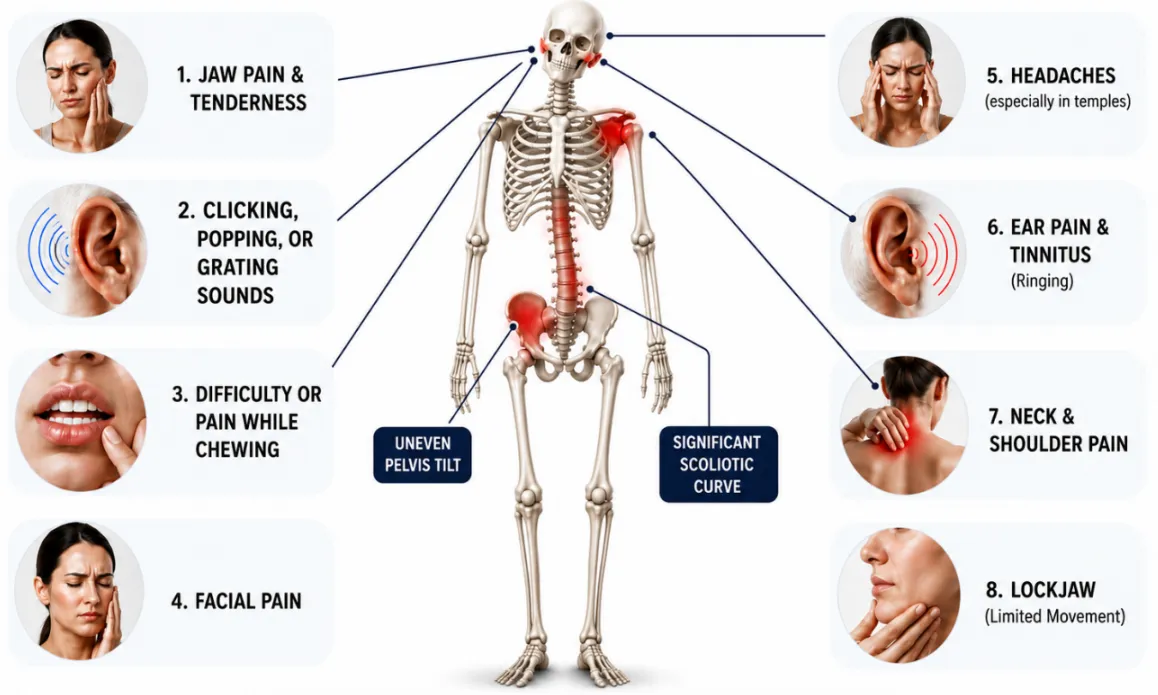
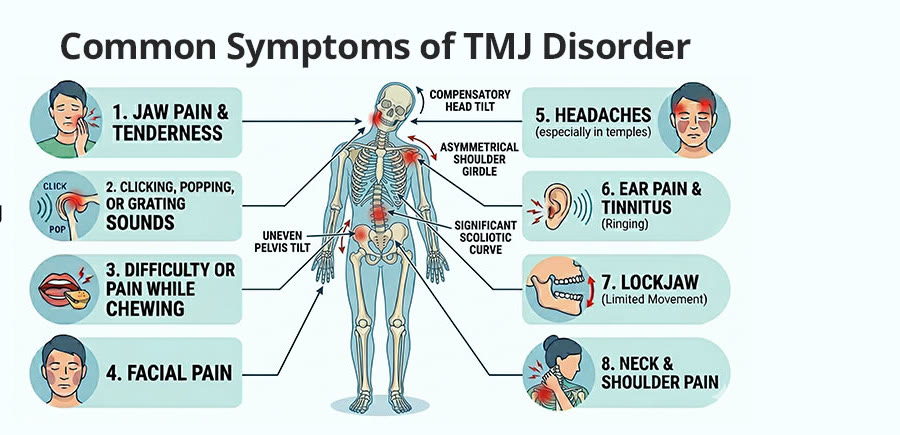
TMD can produce a wide range of symptoms, some of which patients readily connect to the jaw and others that are far less obvious. The following are the most commonly recognized:
- Jaw pain — dull, sharp, or aching; affecting one or both sides; often worse in the morning or after eating
- Clicking, popping, or grating sounds when opening or closing the mouth — see "Clicking & popping — what does it mean?"
- Difficulty opening the mouth fully, or a catching or locking sensation mid-movement
- Jaw locking in an open or closed position — see treating the locked jaw
- Pain or discomfort when chewing, especially with harder or chewier foods
- A change in how the upper and lower teeth come together (bite changes)
Secondary and referred symptoms
These are often overlooked because patients — and sometimes other practitioners — do not immediately connect them to the jaw:
- Headaches, particularly across the temples or at the base of the skull
- Ear pain or a sensation of fullness in the ear, with no sign of infection
- Tinnitus — ringing, buzzing, or hissing in the ear
- Neck and shoulder pain and tension
- Soreness in the facial muscles, especially around the cheekbones and temples
- Chronic tooth sensitivity or pain
- Dizziness — less common, but reported in some cases
Many of these symptoms can also have other causes. If you recognize several of them, an evaluation may help determine whether TMJ dysfunction is a contributing factor. See the practice's TMJ/TMD disorder overview for how the diagnostic process unfolds, or book a TMJ consultation with Dr. Cruz.
Dr. Cruz's clinical note
"The reason I spend so much time on this anatomy page is that, in my experience, patients who understand what the TMJ is and how it works are much better able to participate in their own care. They notice their own symptoms more accurately. They follow the home program more consistently. And they ask better questions at follow-up visits."
"TMD isn't one thing — it's a label for a family of related problems. The first job is always to figure out which of those problems is actually present, and only then to choose treatment. If you've been told you 'just have TMJ' without a clear breakdown of what that means in your case, that's usually a sign the evaluation hasn't been finished."
— Dr. Yolanda Cruz, DDS, Dr. Yolanda Cruz Dentistry On The Path, Downtown Toronto
Frequently asked questions about the TMJ & TMD
The temporomandibular joint (TMJ) is the joint that connects the lower jaw to the skull, just in front of each ear — there are two of them, and they work together every time you chew, speak, or swallow. Unlike the shoulder or knee, the TMJ is a sliding joint with a cartilage disc between the bones; the disc is attached to a muscle and moves during jaw motion. The joint is innervated by a branch of the trigeminal nerve, which is why TMJ dysfunction can produce pain that feels like a toothache, an earache, or sinus pressure.
"TMJ" is the name of the joint itself. "TMD" — temporomandibular disorder — refers to the family of conditions that disrupt the normal function of that joint and the muscles surrounding it. You may also see this described as CMD (craniomandibular dysfunction). In casual conversation people often say "I have TMJ" to mean "I have TMD"; clinically the two are distinct.
There is rarely a single cause. Contributing factors can include trauma to the head, neck, or jaw (including whiplash); bite misalignment (malocclusion); teeth grinding or clenching (bruxism); arthritis within the joint; poor posture, particularly forward head posture; and skeletal asymmetries or developmental variations. In most patients more than one of these is contributing at the same time, which is why a comprehensive evaluation is essential.
It is estimated that as many as one in four people experience TMJ-related symptoms at some point in their lives. Many live with milder forms for years without identifying the underlying cause, because TMD symptoms overlap with so many other conditions and there is no single definitive test for it.
Because TMD symptoms overlap with headaches, ear infections, sinus problems, neck pain, and dental pain — and because the joint is innervated by a branch of the trigeminal nerve, the same nerve that supplies the teeth and face — the symptoms can closely resemble those of toothache, earache, or even neurological conditions. Many patients spend years seeking treatment for those secondary symptoms before a jaw-related cause is identified. See "TMD: The Hidden Condition".
Primary signs include jaw pain (one or both sides), clicking or popping or grating sounds when opening or closing, difficulty opening the mouth fully, locking sensations, and a noticeable bite change. Secondary signs — often missed — include tension-pattern headaches, ear fullness or tinnitus with no infection, neck and shoulder tension, soreness around the cheekbones and temples, and unexplained tooth sensitivity. If several of these have been present for more than a few weeks, an evaluation can determine whether TMJ dysfunction is a contributing factor. Book a TMJ consultation or call 416-595-5490.
Medical Disclaimer
This content is for informational purposes only and does not constitute dental or medical advice, diagnosis, or treatment. TMJ/TMD disorders have multiple possible causes and treatment outcomes vary by individual. Some cases require referral to an oral and maxillofacial surgeon or another specialist. Consult Dr. Yolanda Cruz or another qualified dental professional regarding your symptoms and treatment options. Individual results may vary.
Think your symptoms might be TMJ-related?
Book a focused TMJ evaluation with Dr. Cruz. You'll leave with a working diagnosis and a written plan — no commitment to treatment on day one.