
Clicking & Popping: What Does It Mean?
A clicking or popping sound from the jaw is one of the most commonly reported TMJ symptoms. What that sound means — and when it warrants evaluation — is explained here by Dr. Yolanda Cruz at her TMJ-focused dental practice on the PATH in downtown Toronto.
A clicking or popping sound from the jaw is one of the most commonly reported TMJ symptoms. While an occasional click without pain may not require treatment, these sounds are worth paying attention to, as they can indicate that something within the joint is not moving as it should. This page explains why clicking happens, when a click warrants evaluation, and what an acute jaw lock means. From here you can review the anatomy of the TMJ, the treatment overview, or book a TMJ consultation with Dr. Cruz.
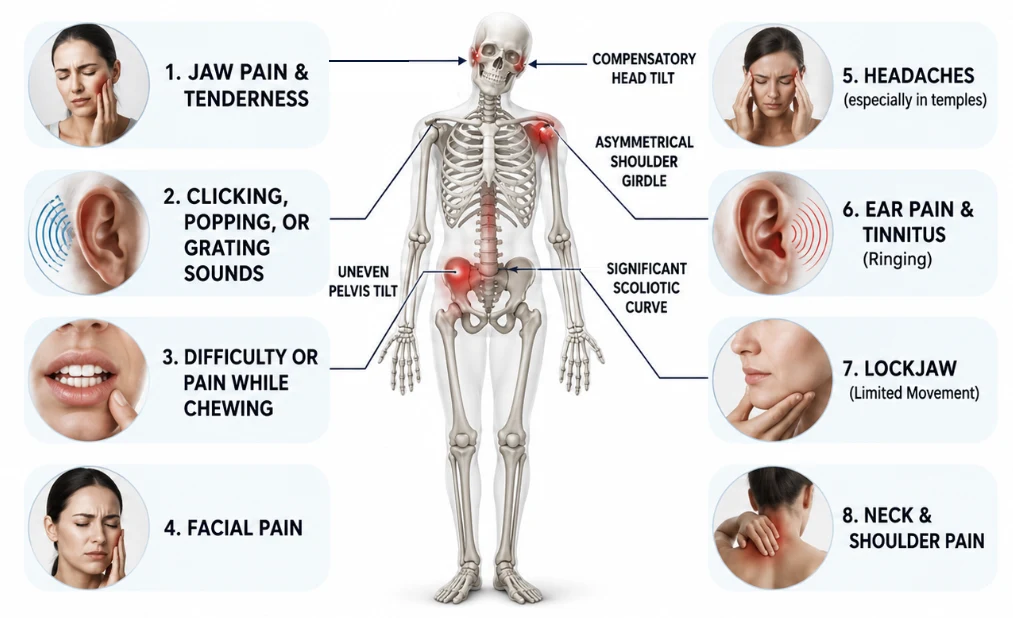
Why clicking occurs
In many cases, clicking occurs because the cartilage disc inside the joint has shifted out of its normal position. As the condyle (the rounded end of the lower jaw) moves during opening or closing, it catches and then passes over the edge of the displaced disc, producing the characteristic sound.
Once you understand that mechanism — condyle catching against a disc that isn’t where it should be — the rest of the picture follows. Sometimes the click is isolated and stable; sometimes it’s a sign the disc is migrating further out of position over time. The job of the evaluation is to tell those two apart.
Reviewed by Dr. Yolanda Cruz, DDS · Dr. Yolanda Cruz Dentistry On The Path · Toronto, ON
Types of joint sounds and what they suggest
Not every jaw sound means the same thing. Patients describe TMJ noises in a range of ways, and the character of the sound — not just its presence — helps direct the evaluation.
A single click
One distinct click during opening or closing, often heard before the jaw is fully open. Frequently reflects the condyle catching and then passing over a slightly displaced disc.
A reciprocal click
A click on opening and a second click on closing. Suggests the disc is being displaced, recaptured by the condyle, then displaced again as the mouth closes.
A pop
A louder, fuller sound than a click — sometimes audible to people nearby. Often indicates a more significant disc displacement or a sudden change in joint mechanics.
Crepitus — a grating sound
A gritty, sandpaper-like sound throughout jaw motion. Less commonly heard than a click; usually associated with arthritic changes in the joint surfaces and warrants evaluation.
A click that disappears
A long-standing click that suddenly goes quiet — especially if it is replaced by limited opening — is a key warning sign and warrants prompt attention.
A click that changes
A click that becomes louder, occurs at a different point in jaw motion, or begins to be accompanied by discomfort — any of these is worth a clinical assessment.
When clicking warrants evaluation
Not every jaw click is an emergency — but several patterns are worth a clinical assessment rather than watching and waiting:
- Clicking accompanied by pain, even mild discomfort
- A click that changes in character, becomes louder, or begins to limit mouth opening
- When a click disappears and is replaced by difficulty opening the mouth fully (acute closed lock), this warrants prompt attention

Disc displacement explained
The cartilage disc inside the TMJ functions almost like a third bone — it sits between the condyle and the temporal bone and is attached to a muscle, so it moves during jaw motion. When the ligaments that hold it in place are stretched or damaged, the disc can shift forward, and the condyle then has to push past it every time the jaw moves.
Disc displacement with reduction describes the situation where the condyle is able to slip past the disc into its normal position during opening — that’s the click. Disc displacement without reduction is the closed-lock pattern: the condyle can no longer get past the disc, so the jaw can no longer open fully.
For the full anatomical picture, see the overview of the TMJ & TMD. The diagnostic process for confirming disc displacement is covered on TMJ/TMD diagnostic technology.
Acute jaw locks
Acute closed lock occurs when a displaced disc fully blocks jaw movement. The mouth cannot open normally, and attempting to do so causes pain. This situation should be assessed as soon as possible.
Acute open lock, the less common opposite, occurs when the jaw becomes stuck in the open position and cannot close without assistance. This also requires prompt care.
Closed lock vs. open lock
The two acute jaw-lock presentations are distinct in their mechanism and in what they feel like to the patient:
- Closed lock — the jaw cannot open beyond a certain point. The disc is fully displaced in front of the condyle and the condyle can no longer slip past it. A previously-clicking joint often goes quiet at the same moment the lock appears.
- Open lock — the jaw is stuck in the open position. The condyle has translated past the articular eminence and cannot return on its own. Less common than closed lock, but equally time-sensitive.
If either of these occurs, prompt clinical assessment is the appropriate next step. See treating the locked jaw or book a TMJ evaluation.
Treatment considerations
Not every clicking jaw requires active treatment. The appropriate course of action depends on a clinical assessment. If you are experiencing jaw sounds along with any pain or limitation, we encourage you to book an exam today.
When treatment is indicated, options at this practice can include a custom oral appliance to reduce joint loading, Botox to muscle hyperactivity that may be aggravating the joint, T-Scan occlusal analysis and Joint Vibration Analysis (JVA) to monitor the joint over time, and — in some cases — specific manoeuvres to attempt to recapture a displaced disc. See TMJ treatment and recapturing the dislocated disc for more.
“My jaw clicks but doesn’t hurt — do I still need a visit?”
Painless clicking can reflect a disc displacement that has been quietly present for years. In many cases it stays stable indefinitely. In others, it progresses — the click changes, pain develops, the joint locks — sometimes years after the patient first noticed the sound.
A single short diagnostic visit lets us establish a baseline: what kind of click it is, whether the disc is reducing, whether there are any other signs of joint loading. From that baseline, future change — if it ever happens — can be picked up early. It also rules out arthritic crepitus and other patterns that warrant a different response.
If you would like that baseline established, book a TMJ consultation or call 416-595-5490.
Dr. Cruz’s clinical note
“The question I’m asked most often about clicking is ‘is it serious?’ The honest answer is: usually no, but sometimes yes — and the only way to know which one applies to you is a short exam. What I’m really listening for at that visit isn’t the click itself; it’s the pattern around it. Is there pain? Has the click changed? Is opening limited? Is there a history of trauma? Each of those moves the picture in a different direction.”
“The one pattern I want every patient to know about is the click that suddenly goes quiet — especially if opening becomes restricted at the same time. That’s a closed lock until proven otherwise, and it’s the situation where time-to-treatment matters most.”
— Dr. Yolanda Cruz, DDS, Dr. Yolanda Cruz Dentistry On The Path, Downtown Toronto
Frequently asked questions about jaw clicking & popping
In most cases, the click is produced by the condyle — the rounded end of the lower jaw — catching and then passing over the edge of a displaced cartilage disc inside the joint. The disc normally sits between the condyle and the temporal bone of the skull and moves smoothly with jaw motion. When the ligaments that hold it in place are stretched or damaged, the disc shifts out of its normal position, and the condyle has to push past it every time the jaw moves — producing the sound. The character of the click (single, reciprocal, painless, painful, changing) helps determine whether evaluation is needed.
An occasional click without pain often does not require active treatment, and many people live with one for years without it progressing. That said, painless clicking can also reflect a disc displacement that may eventually change — the click can become painful, the joint can lock, or the disc can migrate further. A short diagnostic visit lets us establish a baseline so any future change can be caught early.
A click is a sharp, discrete sound, often heard once during opening or closing. A pop is louder and fuller and may be audible to people nearby; it usually suggests a more significant disc displacement. Crepitus is a gritty, grating, sandpaper-like sound that runs through the whole jaw motion rather than occurring at a single point — it is most often associated with arthritic changes in the joint surfaces and warrants evaluation.
Not necessarily. A long-standing click that suddenly goes quiet is a key warning sign — especially if it is replaced by difficulty opening the mouth fully. That pattern often indicates an acute closed lock, where the displaced disc fully blocks the condyle from translating forward. This warrants prompt attention. See treating the locked jaw.
Acute closed lock occurs when a displaced disc fully blocks jaw movement — the mouth cannot open normally, and attempting to do so causes pain. This situation should be assessed as soon as possible. Acute open lock, the less common opposite, occurs when the jaw becomes stuck in the open position and cannot close without assistance. This also requires prompt care.
Patterns worth a clinical assessment include: clicking accompanied by pain, even mild discomfort; a click that changes in character, becomes louder, or begins to limit mouth opening; and any situation in which a previously-clicking jaw goes quiet at the same time opening becomes restricted (a closed lock). If any of these apply, book a TMJ consultation or call 416-595-5490.
Medical Disclaimer
This content is for informational purposes only and does not constitute dental or medical advice, diagnosis, or treatment. TMJ/TMD disorders have multiple possible causes and treatment outcomes vary by individual. Some cases require referral to an oral and maxillofacial surgeon or another specialist. Consult Dr. Yolanda Cruz or another qualified dental professional regarding your symptoms and treatment options. Individual results may vary.
Concerned about a clicking or popping jaw?
Book a focused TMJ evaluation with Dr. Cruz. You’ll leave with a working assessment of the joint sound — and a written plan, only if treatment is indicated.