
What to Expect at Your First TMJ/TMD Examination
A comprehensive diagnostic visit with Dr. Yolanda Cruz for jaw pain, clicking, locking, headaches, bite changes, and facial tension — at our office on the PATH at Bay & Queen, downtown Toronto.
The first TMJ/TMD visit at Dr. Cruz's practice is a focused diagnostic appointment — not a treatment visit. Many patients arrive having been managing symptoms for years, often after seeing multiple practitioners without finding a clear explanation. The goal of this first appointment is to listen carefully, examine thoroughly, and leave you with a working diagnosis and a written plan. No injections, no drilling, no appliance impressions on day one. Schedule your TMJ evaluation or call 416-595-5490.
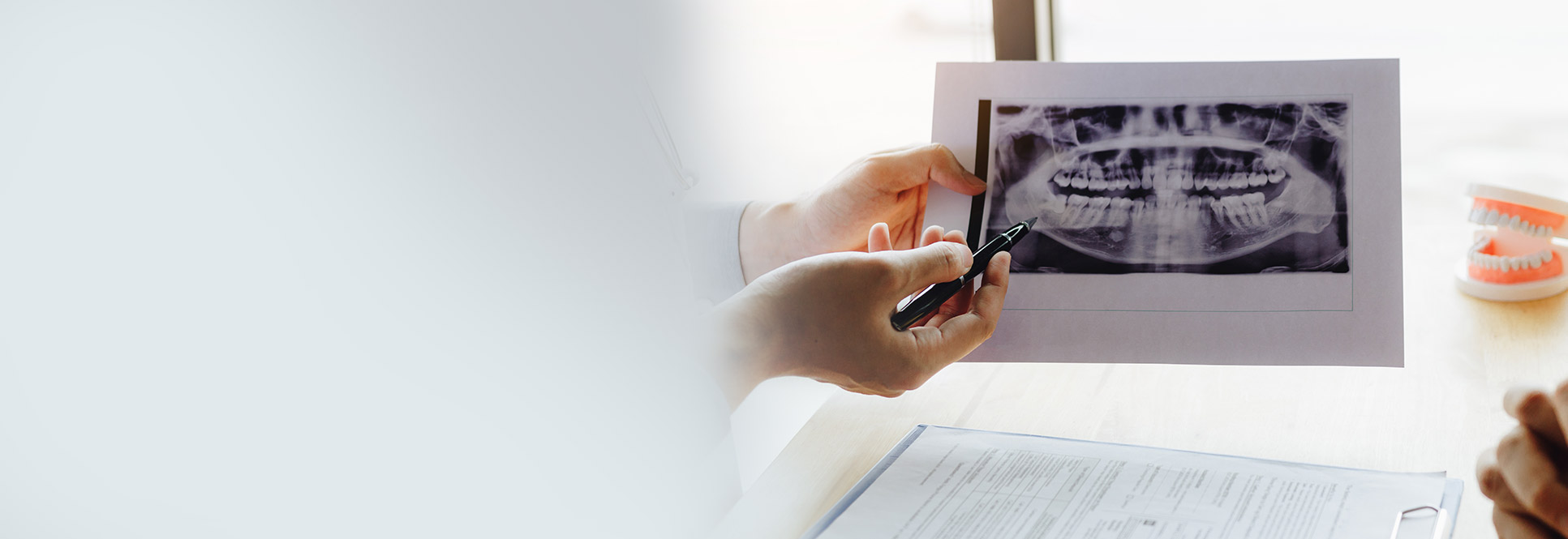
A focused workup — not a quick check
A first TMJ/TMD evaluation at this practice is reserved as a dedicated appointment for understanding your symptoms. It is structured to evaluate the temporomandibular joints, the masticatory muscles, the bite, the airway, posture, and the relevant cranial structures — because TMJ/TMD is rarely caused by a single factor.
The visit is designed to give you a clear picture of what the assessment has found and to put a name on what's actually driving your symptoms — whether that's muscle hyperactivity, internal derangement of the disc, occlusal imbalance, sleep-disordered breathing, postural strain, or a combination of these.
Dr. Yolanda Cruz is a general dentist. All services described on this page are provided within the scope of general dentistry. If imaging or clinical findings indicate a structural problem that needs surgical assessment, you'll be referred to an oral and maxillofacial surgeon.
Reviewed by Dr. Yolanda Cruz, DDS · Dr. Yolanda Cruz Dentistry On The Path · Toronto, ON
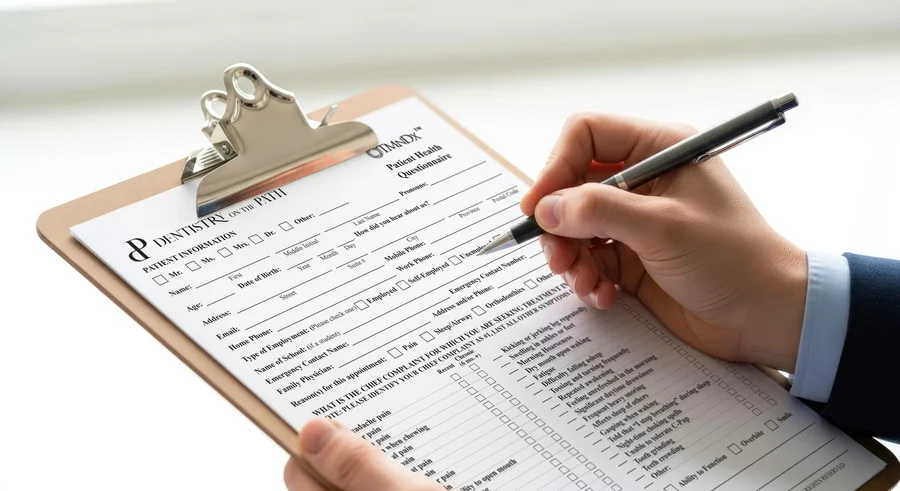
Filling out the questionnaire is part of the workup
When you book your first TMJ/TMD appointment, you'll receive a comprehensive intake questionnaire to complete before your visit. It covers your symptom history, prior treatment, head/neck trauma, sleep, stress, medications, and parafunctional habits (clenching, grinding, gum-chewing). Please take time to fill it in thoroughly — the more detail you can provide, the more informative the visit.
If you haven't received the questionnaire after booking, please contact the office and we'll resend it. If you've had previous panoramic radiographs, CBCT (cone-beam) imaging, MRI of the joints, or a sleep study, bring them — they help reduce duplication of imaging and inform the working diagnosis.
One practical note: please wear tight-fitting clothing for your visit so we can take accurate posture photographs and assess your alignment. Postural compensation patterns are often part of the picture in chronic TMD.
Why diagnosis comes before treatment
At this practice the first visit follows a structured, comprehensive process that draws on the clinical examination, objective diagnostic technology (Joint Vibration Analysis, T-Scan occlusal analysis, and CBCT imaging when indicated), and your reported history. The output of the visit is a working diagnosis plus a written plan — never a treatment commitment.
Chronic TMJ/TMD is a multifaceted condition involving the joints, the masticatory muscles, the nervous system, the bite, and often the upper airway. Effective treatment must address each contributing factor in sequence. A plan for a young grinder with masseter hypertrophy looks very different from a plan for a chronic patient with arthritic changes in the condyle — but the diagnostic framework is the same.
What gets evaluated, and why
Every component below is part of a single, integrated workup — they aren't optional add-ons. Each one contributes to the working diagnosis.
- Medical and dental history We begin with a thorough review of your past medical and dental history, prior treatments, and any head/neck trauma. We ask detailed questions about your current symptoms — their nature, location, duration, what makes them worse, and what brings relief.
- Cranial and structural examination A cranial assessment evaluates the alignment of the skull, the temporomandibular joints, and the dental plane of occlusion relative to the rest of the body. We look for structural asymmetries that may be contributing to symptoms.
- Postural assessment Poor posture is both a common contributor to and a consequence of TMD. The postural exam looks for scoliosis, forward-head posture, lower-back involvement, and leg-length discrepancy that may be perpetuating jaw symptoms. Posture photographs are taken — please wear tight-fitting clothing.
- Functional examinations We assess swallowing pattern (atypical or "tongue-thrust" swallow), breathing mechanics (mouth vs. nasal), and chewing pattern — all of which can contribute to or be affected by TMD.
- Sleep-disorders screening Because sleep-disordered breathing and TMD are closely related — and because nocturnal bruxism often correlates with airway events — every patient is screened for signs of obstructive sleep apnea and snoring. If indicated, we will discuss next steps and facilitate a referral to a sleep physician.
- Dental examination We evaluate the shape and symmetry of the dental arches, assess tooth wear and fracture patterns (a strong indicator of parafunction), review existing restorations, and document findings that inform the diagnosis.
- Neurological screening A focused neurological screen evaluates whether nerve involvement may be contributing to facial pain, numbness, or atypical sensations — particularly relevant for facial-pain presentations and patients with a trauma history.
- TMJ examination Range-of-motion assessment (maximum opening, lateral excursion, protrusion), quality of movement (smoothness, deviation, deflection, speed), assessment for internal derangement, joint inflammation and tenderness, and evaluation of joint sounds — clicking, popping, and crepitation.
- Joint Vibration Analysis (JVA) JVA is a non-invasive technology that records the vibrations produced by the jaw joint tissues during movement. Sensors placed gently over the joints capture the vibration pattern of each joint in motion, which is compared against established norms for healthy joint function. This provides objective diagnostic information that complements the clinical examination — and creates a baseline that can be re-measured to monitor treatment response over time.
Is this diagnostic visit right for you?
This diagnostic appointment is generally appropriate if you have any of the following — particularly when symptoms have been present for several weeks or are worsening:
- Jaw pain or tenderness on one or both sides, especially with chewing, yawning, or wide opening
- Clicking, popping, or grating sounds when you open or close your mouth
- A jaw that catches, deviates, or briefly "locks" — open or closed
- Recurrent tension-pattern headaches in the temples, behind the eyes, or at the base of the skull
- Ear pressure, fullness, or tinnitus with no ENT cause identified
- Noticeable tooth wear, chipping, or sensitivity from suspected bruxism (teeth grinding)
- A bite that feels uneven, shifted, or different than it used to
- A partner who reports loud grinding overnight
- Daytime clenching, facial tension, or fatigue in the chewing muscles
- Symptoms that haven't been explained by previous medical or dental evaluations
This visit may not be the right starting point if your symptoms are acute and trauma-related (a recent jaw fracture or condylar injury), or if you already have imaging suggesting a structural joint problem that needs surgical assessment. In those cases Dr. Cruz will refer you to an oral and maxillofacial surgeon.
What the visit feels like, minute by minute
Most patients tell us the anticipation was worse than the visit itself. Here's the realistic sequence:
- Arrival & intake review (5–10 minutes). A receptionist confirms your completed questionnaire and any imaging you've brought. You'll be seated in a treatment room — no waiting in a generic chair.
- History conversation (15–20 minutes). Dr. Cruz reviews your symptoms, sleep, stress, prior treatment, and trauma history. This is a conversation, not a checklist — you'll be asked to describe what your day feels like, when symptoms started, and what changes them.
- Posture & cranial photographs (5 minutes). Standing photographs from front and side, plus a brief cranial check. This is non-touch and painless.
- Clinical examination (15–20 minutes). Gentle palpation of the masseter, temporalis, and lateral pterygoid muscles, plus the joint capsule itself — you'll be asked to point out anything tender. Range-of-motion measurements with a ruler. A bite check with articulating paper. Joint sounds assessed.
- Joint Vibration Analysis (5 minutes). Small sensors are placed gently over the joints. You'll be asked to open and close several times. No discomfort.
- Imaging discussion (5 minutes). If 3D CBCT imaging is indicated, you'll be informed and consented before any scan. CBCT is not routine — it's added when the clinical findings warrant hard-tissue evaluation.
- Findings & written plan (15–20 minutes). Dr. Cruz walks through what the workup found and presents a working diagnosis. You leave with a written plan, a cost estimate, and time to decide. No treatment is started on day one.
The whole visit runs roughly 120–150 minutes. No injections, no drilling, no appliance impressions on day one — the first visit is diagnostic.
What objective diagnostics give you
The point of this visit isn't to "look at your jaw" — it's to identify what's actually driving your symptoms so the treatment plan addresses the cause, not the symptom alone.
A working diagnosis, not a guess
You leave with a named, working diagnosis — muscle-dominant TMD, internal derangement, arthritic TMJ, bite-driven dysfunction, or a combination — backed by objective data, not a label.
Joint Vibration Analysis baseline
JVA creates a measurable, repeatable record of joint function — so treatment response can be tracked objectively, not just by how you feel that week.
Bite analysis & occlusal mapping
T-Scan and articulating-paper findings identify occlusal interferences and timing issues that contribute to joint loading and muscle hyperactivity.
Airway & sleep screening
Because nocturnal bruxism often correlates with sleep-disordered breathing, every patient is screened — and referred to a sleep physician if warranted.
A written plan, not a sales pitch
The output is a written treatment plan with a cost estimate. You leave with information and time to decide — no pressure to commit to treatment on day one.
A clear "no" when appropriate
If your case needs surgical evaluation or a different specialty, you'll be told — and referred to the right place. Not every case is a fit for conservative dental management.
Basic dental exam vs. focused TMJ/TMD workup
A standard new-patient dental exam at a general practice is not a TMJ/TMD workup. The two visits look superficially similar but answer different questions.
| Component | Standard dental exam | Focused TMJ/TMD workup at this practice |
|---|---|---|
| Visit length | 30–60 minutes | 120–150 minutes |
| Primary purpose | Detect caries, periodontal disease, restorative needs | Diagnose joint, muscle, occlusal, postural, and airway contributors to TMD |
| Joint examination | Brief — palpation and a question about clicking | Range of motion measured, quality of movement assessed, all four muscles palpated, joint sounds evaluated |
| Joint Vibration Analysis | Not performed | Performed — provides objective joint-function data |
| Occlusal analysis | Articulating paper, visual check | Articulating paper plus T-Scan digital occlusal analysis when indicated |
| Posture & cranial assessment | Not performed | Posture photographs, cranial alignment check |
| Airway / sleep screening | Rarely included | Routine — every patient screened, referred to sleep physician if warranted |
| Imaging | Bitewings, panoramic when indicated | CBCT (3D cone beam) when hard-tissue evaluation is clinically warranted |
| Output | Treatment plan for caries / restorative work | Working TMJ/TMD diagnosis, written multidisciplinary plan, cost estimate |
Dr. Cruz's clinical note
"By the time most patients arrive for a TMJ workup, they've already been somewhere else — sometimes several somewhere-elses. They've tried a generic night guard, an anti-inflammatory, a course of massage, maybe an MRI report nobody walked them through. They're frustrated, and reasonably so."
"My job at this first visit isn't to start treatment. It's to name what's actually happening. Is this a muscle problem? A disc problem? A bite-driven problem? An airway problem that's showing up as bruxism at night? A nervous-system-sensitization problem that's been built up over years? Until that's clear, any treatment is a guess — and TMD doesn't respond well to guessing. The objective data from JVA, T-Scan, and a proper postural assessment is what lets me say, with confidence, 'this is what's driving your symptoms — and here's what we do about it, in sequence, starting with the most reversible step.'"
"And occasionally the most useful answer from this visit is that you don't need me — you need a sleep physician, or an ENT, or an oral surgeon. I'd rather get you to the right person on day one than keep you in a chair that isn't the right one."
— Dr. Yolanda Cruz, DDS, Dr. Yolanda Cruz Dentistry On The Path, Downtown Toronto
Risks & considerations
- A first diagnostic visit is not a guarantee of immediate symptom relief — its purpose is accurate diagnosis, which makes subsequent treatment more effective
- TMJ/TMD has multiple possible causes; a working diagnosis may evolve as treatment response is observed
- Some presentations require referral to an oral and maxillofacial surgeon, a sleep physician, an ENT, or a physiotherapist; you'll be told if that applies to you
- CBCT (3D cone-beam) imaging uses ionizing radiation; it is recommended only when the clinical findings warrant hard-tissue evaluation, and is not routine
- Postural and cranial findings sometimes indicate the involvement of musculoskeletal practitioners (physiotherapy, osteopathy, chiropractic) alongside dental care
- The cost of the diagnostic visit and any subsequent imaging is separate from the cost of treatment; you'll receive a written estimate before any treatment begins
- Coverage by extended-health/dental insurance varies by plan; documentation is provided for pre-authorization wherever possible
Frequently asked questions about your first TMJ visit
The first TMJ/TMD diagnostic visit at Dr. Cruz's downtown Toronto practice runs approximately 120–150 minutes. It includes a history conversation, posture and cranial photographs, full clinical examination of the joints and muscles, Joint Vibration Analysis, and a written findings discussion. No treatment is started on day one — you leave with a working diagnosis and a written plan to consider.
No referral is required. You can book directly. If you have one from your physician or another dentist, bring it along with any imaging — it speeds up the history portion of the visit.
Yes — you'll leave with a working diagnosis and a written plan that outlines recommended next steps, the expected sequence (most reversible options first), and a cost estimate. You are not asked to commit to treatment on day one. Most patients take the plan home, read it, and book the next visit when they're ready.
Bring the completed intake questionnaire, any prior imaging (panoramic, CBCT, MRI of the joints, sleep-study reports), a list of current medications, and notes on what makes your symptoms better or worse. Please wear tight-fitting clothing so we can take accurate posture photographs.
Coverage varies by plan. Many Canadian extended-health and dental plans cover at least part of a comprehensive examination and some diagnostic procedures. JVA, T-Scan, and CBCT imaging may or may not be covered depending on the plan. The office provides documentation for pre-authorization wherever possible. The CDCP page outlines what's eligible under the federal plan.
The practice is at 390 Bay St., Concourse Level, Unit C006 — on the PATH at the corner of Bay & Queen, downtown Toronto. The TTC Queen station is one block away and there's underground parking nearby. Full directions and accessibility notes are on the parking & directions page.
Medical Disclaimer
This content is for informational purposes only and does not constitute dental or medical advice, diagnosis, or treatment. TMJ/TMD disorders have multiple possible causes and treatment outcomes vary by individual. Some presentations require referral to an oral and maxillofacial surgeon, a sleep physician, or another specialist. Consult Dr. Yolanda Cruz or another qualified dental professional regarding your symptoms and the appropriate diagnostic workup for your situation. Individual results may vary.
Book your TMJ/TMD diagnostic visit in downtown Toronto
A focused 75–90 minute workup with Dr. Cruz. You'll leave with a working diagnosis and a written plan — no commitment to treatment on day one.