
TMD: The Hidden Condition
Temporomandibular disorder is one of the most commonly missed diagnoses in dentistry and medicine — because its symptoms mimic migraines, ear infections, sinus problems, and cervical spine pain. Dr. Yolanda Cruz explains why a jaw-related cause is so often overlooked.
One of the most challenging aspects of temporomandibular disorder is how its symptoms can resemble those of other conditions. TMD symptoms overlap with a wide range of medical and dental presentations, including migraines, ear infections, sinus problems, cervical spine issues, and neuropathic pain. This overlap means that a jaw-related cause is not always the first thing considered. If you suspect TMD may be the missing piece, schedule a consultation or call 416-595-5490.

Why TMD symptoms can be misleading
The temporomandibular joint shares nerve supply, musculature, and close anatomical proximity with the ear, sinuses, temples, upper and lower teeth, and the cervical spine. When dysfunction occurs at the joint, it can generate pain signals that travel along these connected pathways. This process is known as referred pain.
Because the symptom is felt somewhere other than the joint itself, the patient — and often the first clinician they see — has no obvious reason to suspect the jaw. The ache shows up as a temple headache, an earache, a stuffy-feeling sinus, or a sore neck. The original source can stay invisible for months or years.
Reviewed by Dr. Yolanda Cruz, DDS · Dr. Yolanda Cruz Dentistry On The Path · Toronto, ON
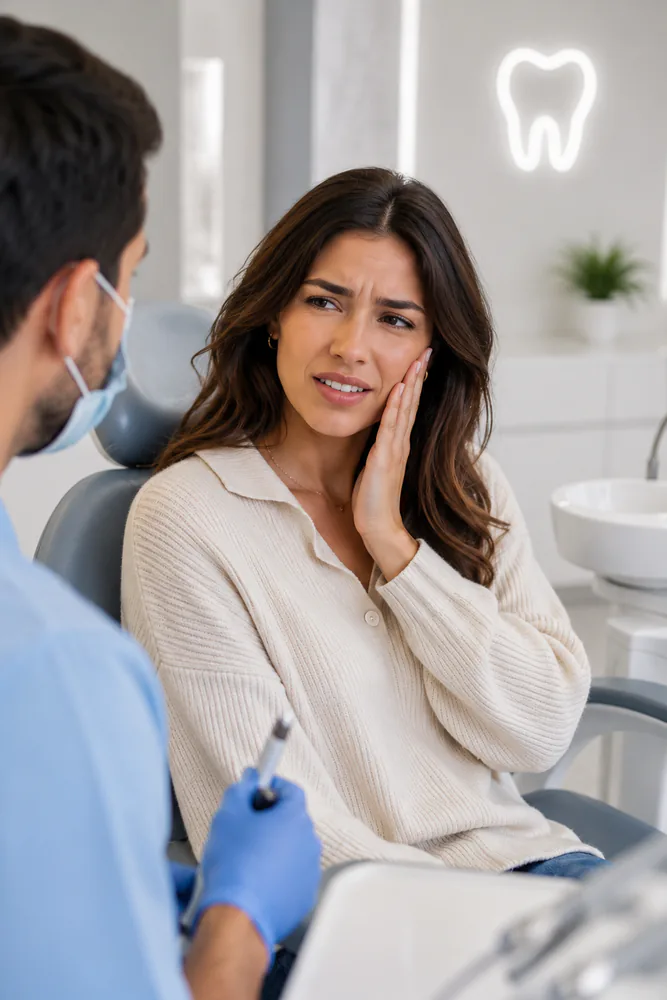
The jaw connects to more than you'd expect
The trigeminal nerve — the largest cranial nerve in the head — supplies the jaw joint, the chewing muscles, the teeth, the sinuses, and most of the face. When the temporomandibular joint and its musculature are irritated, the brain can interpret that signal as pain coming from any other tissue that nerve serves.
That is why a patient with TMD might first be evaluated by a neurologist for headaches, an ENT for ear fullness, a dentist for unexplained tooth pain, or a physiotherapist for a stiff neck — without anyone naming the joint as the contributor. Read the foundational overview of TMJ/TMD for the broader picture.
Conditions TMD is commonly mistaken for
When jaw involvement isn't suspected, TMD is frequently labelled — sometimes for years — as one of the following. Each represents a different pathway by which referred pain or musculoskeletal dysfunction from the jaw can be misattributed.
Migraines & tension headaches
Recurrent temple pain, pressure behind the eyes, and band-like head pain are frequently produced or amplified by hyperactive masseter and temporalis muscles.
Ear infections & tinnitus
Ear fullness, ringing, and a deep ear ache with no ENT finding can reflect TMJ inflammation referring along the auriculotemporal nerve.
Sinus problems
Pressure beneath the cheekbones and tenderness over the maxillary sinuses can be muscular in origin rather than infectious or allergic.
Cervical spine & neck pain
Stiffness at the base of the skull and upper-trapezius tension often co-exist with — and reinforce — jaw muscle dysfunction.
Unexplained tooth pain
A tooth that "feels off" without decay or fracture can be tender from clenching and from joint loading transmitted along shared neural pathways.
Neuropathic facial pain
Burning, tingling, or shock-like facial sensations are sometimes the downstream signal of a chronically sensitized trigeminal system, with the jaw as a contributing input.

The cervicomandibular connection
Cervicomandibular dysfunction describes a pattern in which cervical spine problems and jaw problems interact and reinforce each other. Tight upper-cervical musculature can pull the head forward, alter mandibular rest posture, and increase load on the temporomandibular joint. The reverse is also true — chronic jaw muscle hyperactivity can recruit the upper trapezius and sub-occipital muscles, producing neck stiffness.
Addressing one area without considering the other can lead to incomplete or temporary relief. A patient who has only ever had their neck treated, or only ever had their jaw treated, may continue to relapse until both areas are addressed in coordination.
Why patients often see several specialists before TMD is named
Because TMD presents as someone else's problem, the path to a correct working diagnosis is often long. A common sequence looks like this:
- A family physician evaluates recurrent headaches and prescribes a course of medication
- An ENT investigates ear fullness or unexplained ear pain and finds no infection
- A neurologist works up the headache pattern and rules out a primary neurological cause
- A dentist examines apparently sound teeth that still hurt and finds no decay or fracture
- A physiotherapist treats the neck and upper back with partial, short-lived relief
- Imaging — sometimes including MRI — returns within normal limits because soft-tissue and bite-driven dysfunction does not always show on a static scan
By the time a TMJ-aware evaluation finally happens, the symptom load is layered and the patient is understandably skeptical. A focused diagnostic exam — including muscle palpation, range-of-motion assessment, and (when indicated) TMJ diagnostic technology like T-Scan, Joint Vibration Analysis, and CBCT — is what most often re-frames the picture.
Signs that a jaw evaluation may be the missing step
If you have been working with other specialists and the picture still isn't fitting together, the following findings raise the likelihood that TMD is one of the contributors:
- Headaches that are worse in the morning, or that wake you with sore facial muscles
- A partner who reports loud grinding overnight
- Ear fullness, ringing, or pressure that an ENT could not explain
- Tenderness when you press on the muscles of the cheek, temple, or just in front of the ear
- A bite that feels uneven, shifted, or "off"
- Clicking, popping, or grating sounds when you open or close — even if painless
- Recurring neck and upper-back tension that improves briefly with massage and returns
- Unexplained tooth pain or sensitivity in a tooth your dentist has cleared as healthy
- Symptoms that flare with stress, lack of sleep, or long periods of intense concentration
A comprehensive diagnostic approach
This is why the diagnostic process at Dr. Cruz's practice is thorough and multi-system. The focus is on identifying the true contributing sources of symptoms rather than treating each symptom in isolation.
A first TMJ visit at this practice combines a focused history, palpation of the masseter, temporalis, and lateral pterygoid muscles, range-of-motion assessment, bite analysis with articulating paper and T-Scan, Joint Vibration Analysis when indicated, and a recommendation for CBCT only when hard-tissue evaluation would change the plan. The goal is a working diagnosis — naming what is actually happening — before any treatment is prescribed.
From that point, a personalized plan can be coordinated with the other clinicians already involved in your care — the goal is integration, not replacement of existing therapies that are helping.
Dr. Cruz's clinical note
"Most patients I see for TMD have already been to several other clinicians. They aren't imagining their pain — they're just being treated for the wrong contributor. My role at the first visit is rarely to start treatment; it's to take a careful history and physical exam and decide whether the jaw is genuinely part of what's going on. Naming it is what changes the trajectory of care."
"I'm a general dentist, not a specialist. When the picture suggests a structural or surgical issue, I refer to an oral and maxillofacial surgeon or other specialist — and I tell patients clearly when conservative dental care is, or isn't, the right starting point."
— Dr. Yolanda Cruz, DDS, Dr. Yolanda Cruz Dentistry On The Path, Downtown Toronto
Frequently asked questions about hidden TMD
TMD is missed because its symptoms — headaches, ear pressure, sinus pain, neck tightness, unexplained tooth pain — overlap with conditions that other specialists treat every day. Without a targeted jaw exam (muscle palpation, range-of-motion, bite analysis, T-Scan, JVA), the joint is not the first place clinicians look. The signal is referred along nerve pathways the joint shares with the ear, sinuses, temples, teeth, and cervical spine.
Referred pain is when the brain interprets a pain signal as coming from a tissue different from the one actually generating it. The temporomandibular joint shares nerve supply, musculature, and anatomy with the ear, sinuses, temples, teeth, and neck — so dysfunction at the jaw can produce symptoms that feel like they belong to those structures. That is the core reason TMD is described as "the hidden condition."
Yes. Ear fullness, ringing, and pressure are common TMD presentations because the auriculotemporal nerve serves both the TMJ and the ear. If an ENT examination has not identified an ear cause and the symptoms persist, a TMJ evaluation is worth pursuing — particularly if there is also jaw tenderness, clicking, or morning headaches.
No. Identifying TMD as one of the contributors does not mean other diagnoses were wrong — most patients have more than one input. The goal of a TMJ evaluation is to coordinate care with the clinicians already involved, not to replace them. Dr. Cruz will recommend referral to an oral and maxillofacial surgeon or other specialist when clinically appropriate.
The cervicomandibular connection describes the pattern in which cervical spine dysfunction and jaw dysfunction interact and reinforce each other. Treating only the neck or only the jaw can lead to partial, short-lived relief. A diagnostic plan that considers both areas is generally what produces durable improvement. See the TMJ/TMD overview for more on the joint's anatomy.
Dr. Yolanda Cruz offers focused TMJ/TMD evaluation at 390 Bay St., Concourse Level, Unit C006 — on the PATH at the corner of Bay & Queen, downtown Toronto. The first visit is diagnostic; a written plan and cost estimate follow before any treatment begins. Schedule a consultation or call 416-595-5490.
Medical Disclaimer
This content is provided for general educational purposes only and is not a diagnosis. If you are experiencing symptoms, a professional assessment is recommended. TMJ/TMD disorders have multiple possible causes and treatment outcomes vary by individual. Some cases require referral to an oral and maxillofacial surgeon or another specialist. Consult Dr. Yolanda Cruz or another qualified dental professional regarding your symptoms and treatment options.
Suspect TMD might be the missing piece?
Book a focused TMJ/TMD evaluation with Dr. Cruz in downtown Toronto. You'll leave with a working diagnosis and a written plan — and clarity about whether the jaw is part of what's been going on.